

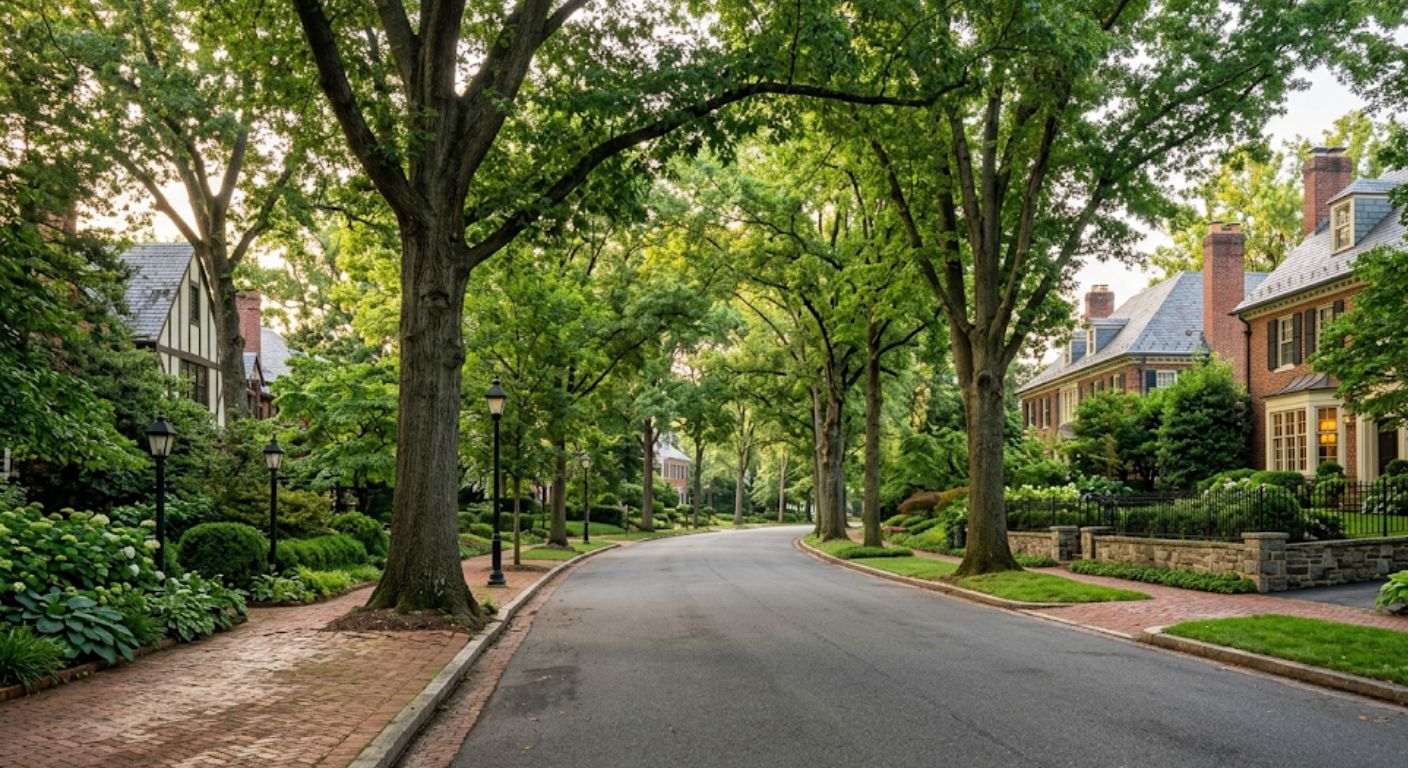
Foxhall’s residential streets are wide, quiet, and heavily canopied, which is a large part of what draws buyers to the area.
Foxhall is not the kind of neighborhood that shows up on lists of trendy DC places to live. That is part of what makes it appealing. It sits in far Northwest Washington, close to the Maryland line, and it has a residential character that is quieter and more removed than most areas at a comparable price point in the city.
For buyers who have looked at the usual Northwest DC options and want something more private, Foxhall tends to come up early in the conversation. Here is what draws buyers to the neighborhood and what has kept it stable over time.
Where Foxhall Sits and What the Area Feels Like
Foxhall runs roughly between Georgetown to the south and the Maryland border to the north, with the Palisades to the west and Wesley Heights nearby to the east. The streets are wide, well-canopied, and low on traffic. There are no commercial strips running through the middle of it. The feeling is residential in a way that very few city neighborhoods can actually deliver.
The housing stock is a mix of large single-family homes, many of them built in the mid-20th century, with formal brick construction, generous setbacks, and mature landscaping. Compared to neighborhoods closer to the city center, lots in Foxhall tend to be larger, which gives properties more separation and outdoor space than buyers often expect to find inside DC.
Why Long-Term Buyers Are Drawn to Foxhall
The buyers who come to Foxhall are typically not chasing the latest hot neighborhood. They are looking for something specific: size, privacy, stability, and a home that will hold its value over time without a lot of drama. Foxhall tends to deliver on all of those.
Turnover in the neighborhood is lower than average. When homes do come to market, they tend to attract buyers who have been watching the area and are ready to move. That combination of limited inventory and consistent demand has kept the market relatively steady through different cycles.
Buyers comparing Foxhall to other Northwest DC luxury options can get useful context from this overview of luxury homes in Northwest Washington DC and how different neighborhoods compare at the upper end of the market.
What the Foxhall Market Looks Like for Sellers
Foxhall is not a high-volume market. In a given year, the number of luxury homes that change hands in the neighborhood is relatively small. That can work in a seller’s favor when the property is well-prepared and well-priced, because buyers who are serious about the area do not have many alternatives to choose from.
The downside of low inventory for sellers is that buyers are also aware of how few options there are. If a home comes to market with significant deferred maintenance or at a price that does not reflect recent comparables, it tends to sit. Buyers in Foxhall are patient and usually not under pressure to move quickly.
According to data tracked by the National Association of Realtors, low-inventory luxury neighborhoods tend to reward sellers who prepare carefully and price accurately from the start, rather than testing the market high and reducing later.
What Buyers Should Understand Before Pursuing Foxhall
Because inventory is limited, buyers who want Foxhall specifically may need to be patient. It is not a market where you can browse 15 homes in a weekend and pick one. When a good property comes available, the buyers who are already familiar with the neighborhood and have done their preparation move first.
Many of the homes in Foxhall are older construction, which means buyers should budget for a thorough inspection and pay attention to mechanical systems, roofs, and any updates that have or have not been made. Well-maintained older homes in the neighborhood can be excellent long-term purchases, but due diligence matters.
Frequently Asked Questions About Foxhall DC Real Estate
What types of homes are available in Foxhall DC?
Foxhall is primarily a single-family home neighborhood. Most of the housing stock consists of mid-century brick homes on larger-than-average DC lots. There are some newer builds and significant renovations, but the neighborhood has largely retained its traditional character.
How does Foxhall compare to Wesley Heights or The Palisades?
All three neighborhoods sit in far Northwest DC and attract similar buyer profiles. Foxhall tends to have slightly larger lots and a quieter character. Wesley Heights is a bit more centrally located. The Palisades has a somewhat more village-like feel closer to the river. The right fit depends on what a buyer values most.
Is Foxhall a good investment for luxury buyers?
Foxhall has shown steady value over time, supported by limited inventory and consistent demand. No specific return is guaranteed, and results depend on the property, price paid, condition, and market timing. Buyers looking for a neighborhood with long-term stability tend to find it appealing for those reasons.
Who typically buys homes in Foxhall DC?
Buyers in Foxhall tend to be long-term Washington residents, senior professionals, and buyers relocating to DC who have done enough research to know what they want. It is not a neighborhood that attracts a lot of first-time buyers or those looking for a starter home.
About Matt Cheney
Matt Cheney is a top-producing real estate advisor with Compass in Washington, DC, guiding buyers and sellers across DC, Maryland, and Virginia through high-stakes moves, from luxury sales to estate settlements, downsizing, and divorce-related transactions. With over $779 million in career sales volume and 22+ years of experience, Matt is ranked in the Top 1.5% of agents nationally by RealTrends America’s Best. He is known for calm, strategic guidance and a straightforward approach to complex and sensitive real estate situations.
Matt Cheney | Compass Real Estate is committed to the principles of the Fair Housing Act and the Equal Opportunity Act. All real estate services are provided without regard to race, color, national origin, religion, sex, familial status, or disability.