

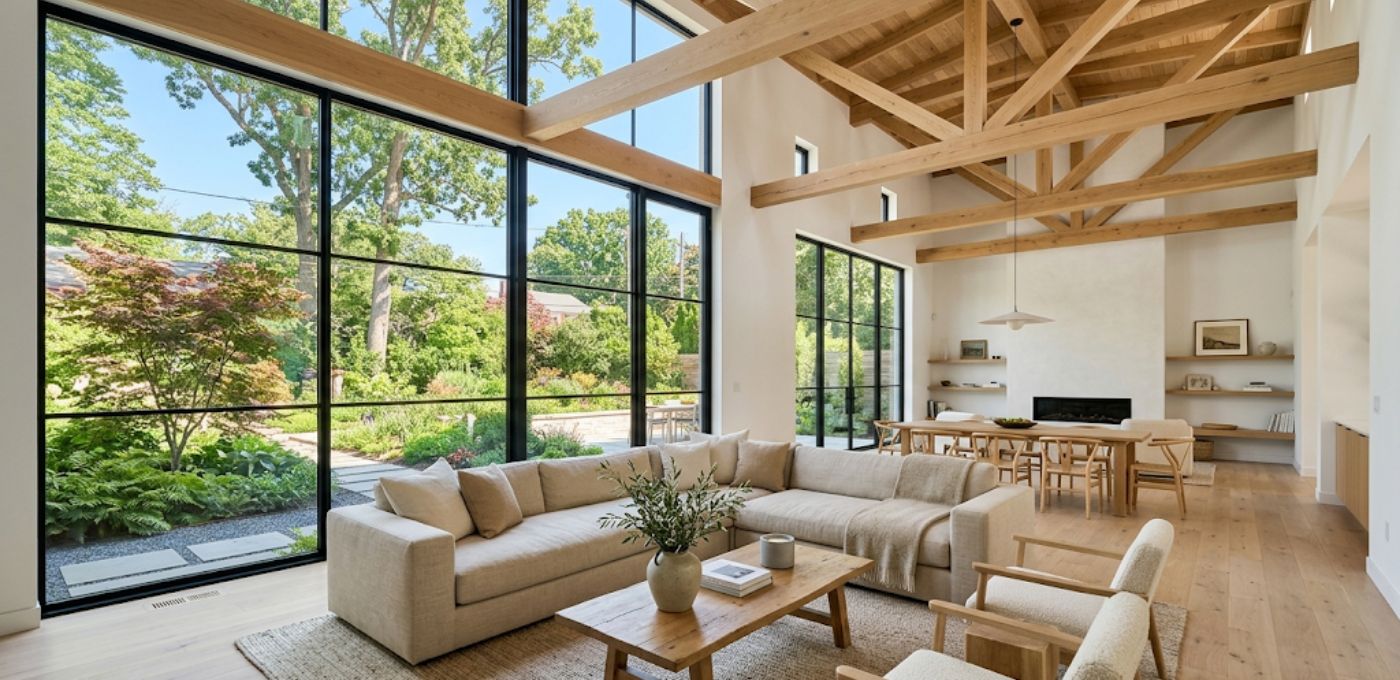
In DC’s luxury market, price per square foot can vary widely depending on location, finishes, ceiling height, and architectural quality.
What Price Per Square Foot Actually Tells You
Price per square foot is one of the most commonly referenced metrics in real estate conversations. The calculation is simple: take the sale price and divide it by the square footage of the home. The result gives you a number buyers and agents use to compare properties and assess whether a listing is in line with the market.
It’s a useful starting point. But in DC’s luxury market, it’s rarely the full story.
Why the Metric Has Limits at the Luxury Level
Price per square foot works best when you’re comparing similar properties in similar locations with similar finishes. In the luxury market, that’s a short list. Here’s where the metric starts to break down:
Location commands a premium that doesn’t scale with size. A 3,000-square-foot home on N Street in Georgetown and a 3,000-square-foot home in a less central part of Northwest DC are not comparable on price per square foot alone. The address carries value that has nothing to do with the interior dimensions.
Lot value is separate from finished square footage. A home on a large lot in Foxhall or Wesley Heights includes land value that isn’t captured in a price-per-square-foot calculation based only on the interior. Two homes with the same square footage can have very different total values because one sits on twice the land.
Quality of finishes varies enormously. A recently renovated luxury home with custom millwork, high-end appliances, and a designer kitchen carries a different value than a comparable-sized home with builder-grade finishes, even if both are in the same neighborhood. Price per square foot doesn’t separate these.
Ceiling height and architectural quality matter. A home with 10-foot ceilings, arched doorways, and original 1920s craftsmanship feels different from a home with standard ceiling heights and no architectural interest. Buyers in the luxury market respond to those differences, and they affect what buyers are willing to pay.
How Buyers Should Use This Metric
That doesn’t mean price per square foot is useless. It’s a quick sanity check. If a listing in a specific neighborhood is priced at twice the per-square-foot average for comparable recent sales, that’s a signal worth investigating. If it’s priced well below the average, it’s worth asking why.
Used as a rough filter, price per square foot helps buyers quickly identify listings that are priced well above or below what the market has recently supported. But it should be followed up with a deeper look at condition, location specifics, lot characteristics, and finishes before drawing any conclusions.
Buyers can explore current luxury real estate market data for Washington DC to get a more grounded picture of what’s happening across different neighborhoods and price points.
You may also like: What are the most desirable neighborhoods for high-end homes in Washington DC, What Every Home Seller in Washington DC Needs to Know Before Listing, and The Best Luxury Neighborhoods in Maryland and Virginia
How Sellers Should Think About It
Sellers sometimes use price per square foot to justify pricing decisions, particularly when their home is larger than comparable sales. The logic is simple: if comparable homes sold at $700 per square foot and my home is bigger, I should ask more.
That logic has limits. Larger homes in DC’s luxury market don’t always command the same per-square-foot premium as smaller ones. Buyers have limited budgets, and the total price matters as much as the per-foot figure. A seller pricing a 5,500-square-foot home based purely on the per-foot average of 3,500-square-foot sales may find the math doesn’t work the way they expected.
A better approach is to look at comparable sales that match the property as closely as possible in location, size, condition, and finishes, and to price based on that reality rather than on a single metric.
What the DC Luxury Market Looks Like Across Neighborhoods
Price per square foot varies considerably across DC’s luxury neighborhoods. Georgetown, Kalorama, and Embassy Row tend to command among the highest figures in the city, driven by location premiums and the scarcity of inventory. Wesley Heights, Spring Valley, and Foxhall offer strong values relative to square footage while still maintaining the privacy and character luxury buyers want.
The DC metro market has been closely watched by analysts at the Urban Institute’s housing research division, which tracks how location premiums and neighborhood dynamics shape pricing across metro areas.
Condos and townhomes often price differently from detached single-family homes even within the same neighborhood, which is another reason the metric requires context before it becomes useful.
Matt’s Approach to Pricing Luxury Homes in DC
Matt Cheney has spent more than 22 years helping buyers and sellers navigate DC’s luxury market. When pricing a home or evaluating a listing, he looks well beyond price per square foot. The analysis includes recent comparable sales, current inventory, location-specific premiums, property condition, and what the buyer pool for a specific home actually looks like right now.
If you’re trying to understand what your home is worth or evaluating a listing you’re considering, a conversation grounded in actual market data is a better starting point than any single metric.
Frequently Asked Questions About Price Per Square Foot in DC Luxury Homes
What is a typical price per square foot for luxury homes in Northwest DC?
It depends on the specific neighborhood, property type, and condition. Values vary significantly across Georgetown, Wesley Heights, Foxhall, Kalorama, and other parts of Northwest. An agent with current sales data can give you a much more useful range than any general figure.
Is price per square foot more useful for condos or single-family homes?
The metric tends to be more reliable for condos in the same building or development, where units are more comparable. For single-family homes, especially luxury properties with varying lot sizes and architectural character, it’s a much rougher guide.
Why does price per square foot differ so much within the same neighborhood?
Condition, renovation quality, lot size, street location, view, ceiling height, and architectural character all affect what buyers are willing to pay. Two homes on the same block can trade at very different per-foot figures if one has been fully renovated and the other hasn’t been touched in 20 years.
Should I use price per square foot to decide what to offer?
Use it as a starting point, not as a final answer. Look at the comparable sales your agent pulls, not just the per-foot average. Understand what those comps actually look like relative to the property you’re considering. That analysis produces a more informed offer than any single metric can.
About Matt Cheney
Matt Cheney is a top-producing real estate advisor with Compass in Washington, DC, guiding buyers and sellers across DC, Maryland, and Virginia through high-stakes moves, from luxury sales to estate settlements, downsizing, and divorce-related transactions. With over $779 million in career sales volume and 22+ years of experience, Matt is ranked in the Top 1.5% of agents nationally by RealTrends America’s Best. He is known for calm, strategic guidance and a straightforward approach to complex and sensitive real estate situations.
Matt Cheney | Compass Real Estate is committed to the principles of the Fair Housing Act and the Equal Opportunity Act. All real estate services are provided without regard to race, color, national origin, religion, sex, familial status, or disability.