

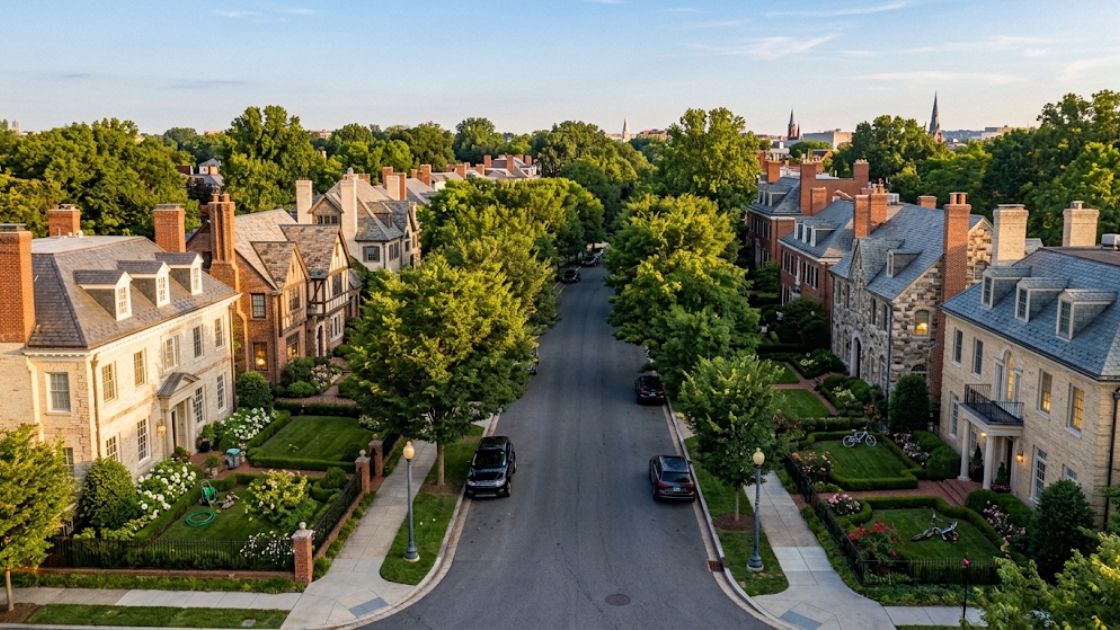
Washington, DC’s priciest neighborhoods combine historic architecture with enduring long-term value.
Why Washington, DC Remains One of the Top Luxury Real Estate Markets in the Country
Washington, DC has long attracted buyers who want more than just a home. They want a neighborhood with character, history, walkability, and lasting value. For high-end buyers and sellers, that combination exists in a handful of truly special communities scattered across the city and its close-in suburbs.
Whether a client is relocating for work, upgrading to a larger property, or selling a home that has appreciated significantly over the years, knowing where the most desirable luxury homes are concentrated can make all the difference in strategy. Matt Cheney has spent over 23 years guiding buyers and sellers through DC’s most competitive luxury transactions. In that time, he has seen which neighborhoods hold their value, which ones attract the most competitive offers, and where serious buyers are focused right now.
This guide walks through the neighborhoods that consistently rise to the top for luxury buyers and sellers in Washington, DC. It covers what makes each area distinctive, what price ranges typically look like, and what buyers and sellers need to know before making a move in any of these communities.
What Are the Most Expensive Neighborhoods in Washington, DC?
When people ask about the most expensive neighborhoods in Washington, DC, a consistent group of communities comes up again and again: Kalorama, Georgetown, Spring Valley, Foxhall, and Wesley Heights typically rank at the top for the District’s highest sale prices, with Massachusetts Avenue Heights, Berkley, and Observatory Circle also commonly cited among the city’s priciest addresses. Cleveland Park and Chevy Chase, DC round out the list for buyers seeking a slightly more accessible entry point into the city’s luxury tier.
- Kalorama — home to some of DC’s most significant detached mansion properties, with the largest homes reaching well into eight figures.
- Georgetown — the city’s most recognized address, where larger historic estates and double-wide row homes routinely trade in the multi-million dollar range.
- Spring Valley — large lots and substantial homes drive some of Northwest DC’s biggest single-family transactions.
- Foxhall — wooded, low-density lots near the Potomac that attract buyers seeking privacy and larger footprints.
- Wesley Heights — generous square footage and lot size just west of Spring Valley, with strong, steady luxury demand.
- Massachusetts Avenue Heights, Berkley, and Observatory Circle — smaller, tightly held enclaves near the Naval Observatory and Embassy Row known for architectural significance and limited inventory.
- Cleveland Park and Chevy Chase, DC — offer more square footage per dollar than the city’s most prominent addresses, making them a common landing spot for buyers seeking a premier Northwest DC location.
Rankings shift year to year depending on which specific sales close, so buyers and sellers comparing these neighborhoods should contact Matt directly for current data on recent sales in any of these areas.
The Neighborhoods That Define Luxury Living in Washington, DC

From Georgetown’s rowhouses to Kalorama’s mansions, DC’s most expensive neighborhoods each offer a distinct luxury setting.
Spring Valley
Spring Valley is one of the most consistently sought-after neighborhoods in all of Northwest DC. Located in the upper northwest quadrant of the city near American University, this community is known for its large lots, mature trees, and substantial brick and stone homes built primarily in the 1930s and 1940s. The scale of the properties here is rare for an urban setting, and that combination of size, privacy, and city access makes Spring Valley genuinely hard to replicate.
Buyers in Spring Valley are typically looking for space without sacrificing proximity. The neighborhood sits close to strong public and private schools, easy access to the Friendship Heights and Tenleytown corridors, and a quiet, established feel that is difficult to find inside the District. As of mid-2026, single-family homes in Spring Valley have generally been trading in the $2 million to $5 million range, with larger estates reaching well beyond that. Buyers and sellers should contact Matt directly for a current market analysis and recent sales data, as pricing in this range can shift meaningfully with market conditions.
For sellers, Spring Valley tends to reward preparation. Buyers at this price point are informed and deliberate. Presentation, pricing strategy, and timing all matter more here than in lower price brackets, and working with an advisor who knows this market well gives sellers a real advantage.
Wesley Heights
Adjacent to Spring Valley and sharing many of the same characteristics, Wesley Heights is a neighborhood that carries strong appeal for luxury buyers who want generous square footage and generous outdoor space within the District. The homes here tend to be larger, and the community maintains a suburban feel while remaining very much part of the city.
Wesley Heights draws a mix of long-term DC families, diplomatic community members, and buyers relocating from other major metro areas who want something with permanence and quality. The neighborhood’s proximity to major embassies, international institutions, and private schools adds to its consistent appeal.
Properties in Wesley Heights are typically priced in the $1.8 million to $4.5 million range depending on size, condition, and lot. The market here is active but not as competitive as some of the city’s more central luxury enclaves, which can create favorable conditions for buyers who are well-prepared.
Kent and Foxhall
Kent and Foxhall Village sit along the Palisades area of Northwest DC and offer some of the most distinctive residential settings in the city. These are neighborhoods where buyers will find wooded lots, views of the Potomac River, and homes that feel removed from the pace of urban life while still being remarkably close to Georgetown, downtown DC, and Virginia just across the Chain Bridge.
Kent in particular has attracted buyers who prioritize privacy and natural setting. The homes range from mid-century originals to newer construction and thoughtful renovations, and prices typically fall between $1.5 million and $4 million. Foxhall tends to draw buyers with larger families or those seeking more land, and larger properties there can exceed $5 million.
The combination of water proximity, wooded character, and limited inventory makes Kent and Foxhall perennially competitive for buyers, particularly in the spring market. For sellers in these neighborhoods, understanding how to market the lifestyle as much as the square footage is essential.
Georgetown
Georgetown is perhaps the most globally recognized neighborhood in Washington, DC, and for good reason. This is one of the oldest and most architecturally significant communities in the country, with Federal-style townhomes, carriage houses, and historic estates lining streets that have seen more than two centuries of American history. Matt Cheney has closed more than $79M in career sales volume in zip code 20007, giving him a level of market-specific knowledge in this neighborhood that is difficult to find elsewhere.
Luxury buyers in Georgetown are drawn by the neighborhood’s extraordinary combination of walkability, prestige, and architectural character. The commercial stretch along M Street and Wisconsin Avenue provides some of the best restaurants, boutiques, and cafes in the city. Access to the C&O Canal towpath and waterfront parks adds to the appeal for those who value outdoor access.
Georgetown prices vary widely based on block, condition, and whether a property has outdoor space, parking, or historic significance. Entry-level luxury condos and smaller townhomes can be found in the $1 million to $2 million range, while the larger historic estates and double-wide row homes trade between $3 million and $8 million or more. Georgetown is one of the few DC neighborhoods where price per square foot routinely climbs into four-figure territory.
Kalorama
Kalorama is where ambassadors, cabinet members, and former presidents have chosen to live, and that alone tells you something about the neighborhood’s standing. Located in upper Northwest DC between Adams Morgan and Rock Creek Park, Kalorama combines architectural grandeur with an incredible park-adjacent setting and a surprisingly residential feel for a neighborhood so close to the heart of the city.
The homes in Kalorama include some of the most impressive detached residences in all of Washington, DC. Large Beaux-Arts mansions, substantial brick colonials, and gracious pre-war buildings define the streetscape.
Prices in Kalorama reflect that reality. The most significant detached homes can reach $10 million or more, while high-floor condominiums in the neighborhood’s well-maintained pre-war buildings offer entry points in the $800,000 to $2 million range. Inventory is limited and often absorbed quickly when correctly priced.
Cleveland Park and Cathedral Heights
For buyers who want a neighborhood feel, walkability, and access to Rock Creek Park along with properties that tend to offer more square footage per dollar than some of the city’s more prominent luxury addresses, Cleveland Park and Cathedral Heights represent genuine value within the upper tier of the DC market.
Cleveland Park is anchored by its independent businesses, tree-canopied streets, and a Metro stop that makes commuting easy. The homes here tend to be large Victorian and Craftsman-era single-family properties on substantial lots, and they attract buyers who want the character of an older neighborhood combined with the practicality of urban living. Prices generally range from $1.5 million to $3.5 million for the larger single-family homes.
Cathedral Heights offers a quieter residential experience near the Washington National Cathedral, with larger properties and fewer through streets. The neighborhood appeals to buyers prioritizing space, low traffic, and a quieter setting within the District, and the proximity to the Cathedral grounds and nearby parks adds to its distinctive character.
You may also like: Average Price Range for Luxury Homes in Washington DC Neighborhoods, Georgetown vs. Kalorama: Which DC Luxury Neighborhood Is Right for You in 2026, and Chevy Chase Maryland vs Chevy Chase DC, Which Neighborhood Fits Your Goals in 2025
Close-In Maryland: Bethesda, Chevy Chase, and Potomac
A true luxury market guide for the Washington, DC area would not be complete without acknowledging the neighborhoods just over the Maryland border that draw significant luxury buyer interest.
Bethesda
Bethesda has evolved into one of the most competitive luxury markets in the entire DC region. With school options buyers often evaluate carefully, a walkable downtown core, and consistently strong property values, Bethesda draws buyers from the District who are ready to trade city living for slightly more space. Buyers should verify current school information directly, as assignments and ratings can change. Luxury single-family homes in Bethesda’s most desirable pockets, including Bradley Hills, Burning Tree, and Edgemoor, regularly sell between $2 million and $6 million.
Chevy Chase, Maryland
The Maryland side of Chevy Chase offers larger lots and established tree-lined streets with easy access to DC. The community sits adjacent to the DC border and benefits from both worlds: proximity to the District and the property size and school access that Maryland provides. Homes in Chevy Chase, MD typically range from $1.5 million to $4 million in the upper tier.
Potomac
For buyers seeking significant acreage, equestrian properties, or estate-scale homes, Potomac, Maryland is the destination in the DC metro area. Properties here can occupy two to ten or more acres, and the community’s horse country character combined with access to highly regarded private and public schools makes it a consistent draw for high-net-worth buyers. Luxury homes in Potomac range widely from $2 million to well above $10 million.
Virginia: McLean, Great Falls, and Arlington
McLean
McLean, Virginia is home to some of the most significant residential estates in the entire DC metro area. Its proximity to the CIA, major employers along the Dulles Corridor, and Washington, DC via the George Washington Memorial Parkway makes McLean a consistent choice for executives, diplomats, and government officials. Luxury homes in McLean’s established communities can range from $2 million to $15 million or more.
Great Falls
Great Falls offers a more rural luxury experience, with larger lots, fewer restrictions, and extraordinary natural beauty along the Potomac River. For buyers who want land, privacy, and the ability to build or extensively renovate on a meaningful scale, Great Falls delivers in ways that few other DC-area communities can match. The luxury range here starts around $1.5 million and extends to $7 million or higher for the most significant properties.
Arlington
Arlington has seen notable luxury market activity in recent years, driven by major employer presence, transit access, and the ongoing redevelopment of areas like Rosslyn, Ballston, and Crystal City. For buyers who want a high-end urban experience with Virginia’s tax structure and meaningful appreciation potential depending on property and timing, Arlington continues to attract serious buyer interest. Luxury condominiums and larger single-family homes have generally ranged from $1 million to $3 million, though buyers should contact Matt directly for a current market analysis and recent sales data.
What Sets High-Value Neighborhoods Apart
Buyers and sellers in the DC luxury market often ask what actually separates a premier neighborhood from a merely good one. Over more than two decades working in this market, Matt Cheney has found that the most consistently valuable neighborhoods share a few important characteristics.
Limited inventory is one of the most powerful drivers. Neighborhoods like Kalorama, Kent, and Spring Valley have hard geographic boundaries, meaning supply will always be constrained. Limited supply combined with sustained demand produces the kind of long-term appreciation that protects buyer investment.
School access, both public and private proximity, consistently influences buyer demand across price points. Even buyers without children factor school quality into their analysis because it affects resale value.
Walkability and park access have become increasingly important over the past several years. Neighborhoods adjacent to Rock Creek Park, the C&O Canal, or the Potomac River consistently command premiums that are measurable and durable.
Finally, architectural character matters in a way that is hard to fully quantify but very easy to observe in pricing. Historic neighborhoods with protected streetscapes, mature trees, and distinctive home styles hold value in ways that newer subdivisions rarely match.
How to Approach Buying or Selling in the DC Luxury Market
The DC luxury market operates differently from the broader market in several important ways. At higher price points, the buyer pool is smaller and more discerning. Marketing needs to reach specific audiences, often nationally and internationally. Pricing strategy requires detailed, neighborhood-specific analysis rather than relying on broad market averages. And the negotiation dynamic at this level demands an advisor with direct experience in high-stakes, high-value transactions.
For buyers, the most important step is getting clarity on which neighborhoods align with actual priorities before narrowing the search. Many buyers enter the DC luxury market with one neighborhood in mind and end up finding the best fit in a community they had not initially considered.
For sellers, preparation and positioning are everything. A well-prepared, correctly priced home in any of these neighborhoods can generate multiple offers quickly. A home that enters the market without that preparation can sit, even in a strong price range.
Why DC-Area Clients Work with Matt Cheney
With over $779M+ in career sales volume and 22+ years of experience across Washington, DC, Maryland, and Virginia, Matt Cheney has built his practice on something straightforward: giving clients the honest, strategic guidance they need to make confident decisions. He is recognized by RealTrends as being in the Top 1.5% of agents nationwide, and his business is built primarily on referrals, which means every client relationship matters enormously to him.
Matt does not specialize in volume for its own sake. He specializes in outcomes.
Whether a client is buying a historic Georgetown townhome, selling a Spring Valley estate, or navigating a complex transition in Potomac or McLean, Matt brings the same calm, data-driven approach to every situation.
Steps for Buyers Entering the DC Luxury Market
- Define priorities clearly before searching. Space, school access, commute, outdoor access, and architectural character can each point toward a different neighborhood. Clarifying what matters most before beginning the search saves significant time and reduces frustration.
- Get fully pre-approved, not just pre-qualified. At the luxury level, sellers expect buyers to be genuinely ready. A soft pre-qualification letter will not put a buyer in a competitive position.
- Understand that off-market opportunities are real in this price range. A meaningful share of DC luxury transactions happen quietly, before a home ever reaches the public market. Working with an advisor who has deep neighborhood relationships gives buyers access to these opportunities.
- Think about the exit from day one. The best luxury purchases are those where a clear, confident path to selling well already exists. Buyers should consider lot size, architectural character, and school district stability when evaluating any property.
- Move deliberately but without hesitation when the right property appears. DC luxury buyers who overthink and lose a property they wanted often regret it more than buyers who moved quickly on a home they loved.
Steps for Sellers in the DC Luxury Market
- Time the listing strategically. Spring is typically the strongest season for luxury residential sales in the DC area, but late fall and early winter have produced exceptional results for well-positioned properties in recent years. Timing depends on the neighborhood and the specific home.
- Invest in presentation before listing. Professional staging, high-quality photography, drone and video content, and a strong digital marketing presence matter more at the luxury level than at any other price point. Buyers are making larger decisions and expect a higher quality of information.
- Price based on data, not aspiration. Overpricing is the most common mistake luxury sellers make in the DC market. A home that sits unsold for 60 or 90 days loses momentum and credibility that is very difficult to recover.
- Work with an advisor who has a proven track record in the specific neighborhood. General experience is not the same as neighborhood-specific expertise. The nuances of the Spring Valley market are different from the Georgetown market, which is different from Kalorama. Specific knowledge produces better outcomes.
- Understand net proceeds clearly before listing. Transfer taxes, agent fees, staging costs, and any repairs or updates made prior to listing all affect the bottom line. A good advisor will model this in detail before any decisions are made.
Frequently Asked Questions About DC Luxury Neighborhoods
What is the most expensive neighborhood in Washington, DC?
Kalorama, Georgetown, and Spring Valley consistently rank among the highest in median sale price for the District. For detached single-family estates, Spring Valley and Kent tend to produce the city’s largest transactions. Kalorama is home to some of the most significant detached mansion properties in all of DC.
Where do luxury buyers look in the DC metro area beyond the District?
McLean and Potomac in Virginia and Maryland respectively are the most prominent luxury destinations outside the city. Both communities attract buyers who want larger lots and estate-scale properties while remaining within a reasonable commute of Washington, DC. Bethesda is also a consistent top choice for buyers moving from the city to Maryland.
Is it better to buy a luxury home in DC or in the suburbs?
This depends almost entirely on individual priorities. The District offers architectural character, walkability, and proximity to cultural and professional life that the suburbs cannot match. Suburban Maryland and Virginia offer more land, larger homes per dollar in many cases, and access to strong public school systems. Many of Matt’s clients evaluate both before making a final decision, and there is rarely one universally correct answer.
How long do luxury homes in DC typically stay on the market?
Well-priced, well-presented luxury properties in premier DC neighborhoods can sell in days to weeks, even at the $3 million to $6 million price point. Overpriced or poorly prepared homes at the same level can sit for months. The DC luxury market rewards preparation and accurate pricing consistently.
What neighborhoods in DC have the best long-term investment value?
Neighborhoods with limited new supply, strong school access, park proximity, and historic architectural character have historically delivered the most consistent long-term appreciation in the DC metro area. Spring Valley, Georgetown, Kalorama, and close-in McLean and Bethesda have all demonstrated this pattern over multiple market cycles.
Who is the best realtor to sell a luxury home in Washington, DC?
The right advisor is one with direct, current experience in the specific neighborhood where a client is selling. Track record matters, but so does active engagement with the local buyer pool, strong marketing capabilities, and the judgment to price correctly in a complex market. Matt’s clients often point to these qualities when describing why they chose to work with him and why they refer their friends and family.
What makes Spring Valley different from other Northwest DC neighborhoods?
Spring Valley stands out because of its lot sizes, which are exceptionally large for an urban setting, its consistently high property values, and its established residential character with minimal through traffic. The combination of privacy, space, and city access is genuinely rare and drives strong, durable buyer demand.
Is Georgetown still a good investment for luxury buyers in 2026?
Georgetown remains one of the most resilient luxury markets in the country. Its combination of historic character, architectural protection, walkability, and international recognition as a premier DC address creates a demand floor that does not exist in most markets. Georgetown homes at the higher end of the price spectrum require careful analysis, but the neighborhood’s fundamentals remain strong in 2026, and the long-term trajectory for well-positioned properties here continues to reflect durable demand.
A Final Word
Washington, DC and the surrounding metro area offer a range of luxury living options that are genuinely difficult to find anywhere else in the country. The combination of historic architecture, cultural institutions, natural beauty, and strong long-term property values makes the DC market one of the most distinctive luxury environments in the United States.
Whether a buyer is looking for the right neighborhood to match their priorities, or a seller is ready to make the most of what they have built in one of these exceptional communities, the most important step is working with someone who knows this market at depth.
Matt Cheney would be glad to talk through where a client is in the process and what might make sense for them. Reach out anytime through MattSold.com.
About Matt Cheney
Matt Cheney is a top-producing real estate advisor with Compass in Washington, DC, guiding buyers and sellers across DC, Maryland, and Virginia through high-stakes moves, from luxury sales to estate settlements, downsizing, and divorce-related transactions. With over $779 million in career sales volume and 23 years of experience, Matt is ranked in the Top 1.5% of agents nationally by RealTrends America’s Best. He is known for calm, strategic guidance and a straightforward approach to complex and sensitive real estate situations.
Matt Cheney | Compass Real Estate is committed to the principles of the Fair Housing Act and the Equal Opportunity Act. All real estate services are provided without regard to race, color, national origin, religion, sex, familial status, or disability.
Real estate considerations related to divorce or estate matters involve legal and financial complexities. Consult a qualified attorney and financial advisor for guidance specific to your situation.