

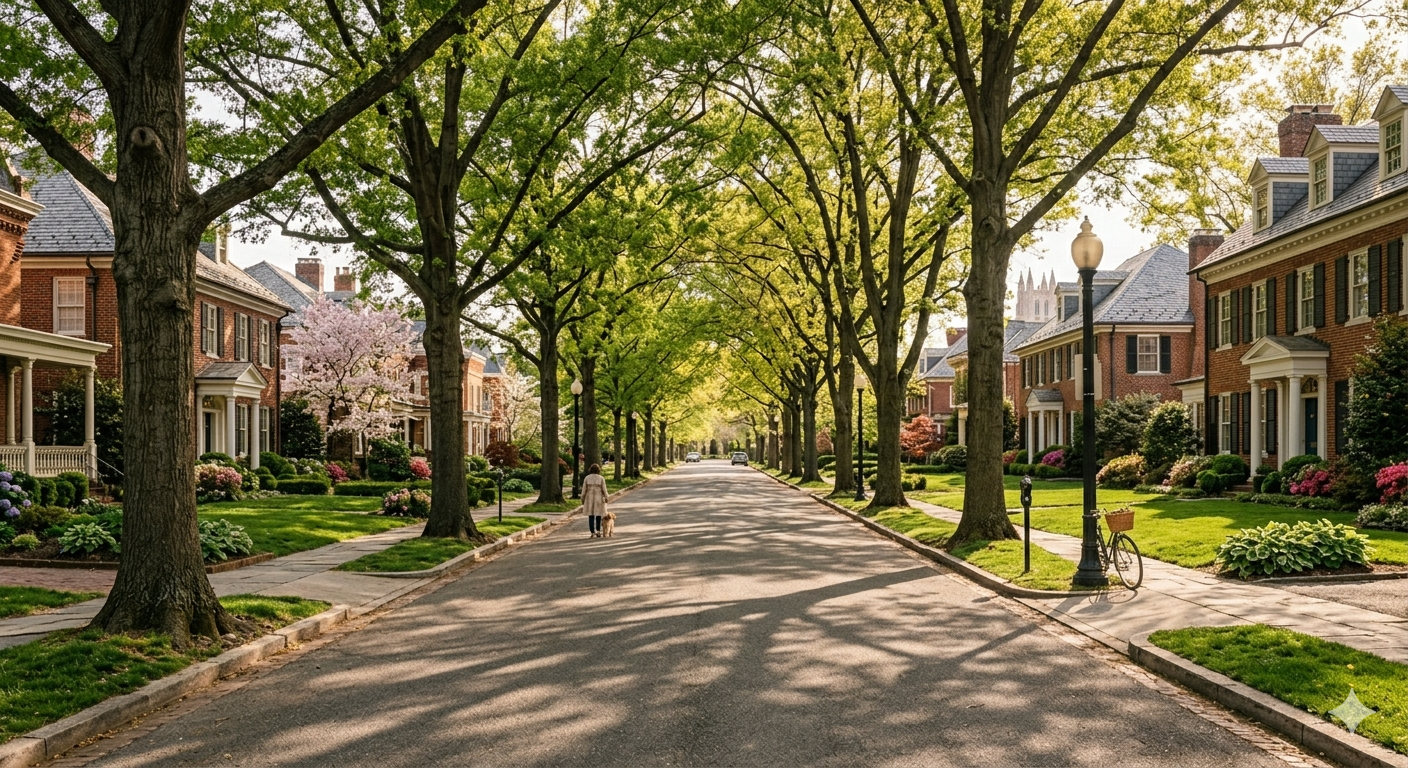
Forest Hills delivers something increasingly rare in Washington DC: generous space, mature tree canopy, architectural variety, and a neighborhood pace that feels nothing like the rest of the city.
The Neighborhood That Earns Repeat Attention
Washington, DC has dozens of well-regarded neighborhoods, but only a handful that tend to produce the same reaction from buyers who discover them for the first time. Forest Hills is one of those places. Tucked into the northwest quadrant of the city, bordered by Rock Creek Park on the east and Connecticut Avenue on the west, it sits between Chevy Chase to the north and Cleveland Park to the south, and it feels almost entirely apart from the city that surrounds it.
Buyers who come to Forest Hills, often called Van Ness because of its proximity to the Van Ness-UDC Metro station, tend to arrive having looked at comparable neighborhoods and decided they want something different. They want generous lots and mature trees. They want architectural variety that ranges from traditional colonials to genuinely distinctive modernist homes. They want quiet streets and park access and a neighborhood that rewards being a resident rather than just a commuter.
This guide covers what living in Forest Hills actually looks like: the housing, the streets, the schools, the parks, the restaurants, and the market dynamics that shape what it takes to buy here. If you are ready to explore specific listings, the post on finding the best real estate agent in Forest Hills DC is a good next step.
Understanding Forest Hills: Location and Layout
Forest Hills occupies an elongated stretch of upper Northwest DC. Its formal boundaries run from Connecticut Avenue NW on the west to Rock Creek Park on the east, from Chevy Chase DC and Maryland to the north down to Tilden Street NW to the south. In practice, the neighborhood blends at its edges with Cleveland Park, North Cleveland Park, and the Van Ness corridor, which is why many residents use the names interchangeably.
What defines Forest Hills as a place is not just its borders but its topography. The land rolls and rises in a way that is unusual for a city neighborhood, producing winding streets, unexpected views, and lots that feel genuinely suburban in their proportions. Development here was intentional and low-density, and zoning protections that limit building heights and ground coverage have preserved that character across generations of ownership.
The neighborhood is officially designated a Tree and Slope Protection Overlay District, which means the canopy and hillside landscape that give Forest Hills its distinctive feel are actively protected. This is not an accident of geography. It reflects deliberate policy that has kept the neighborhood from being densified the way many other DC corridors have been, and it is one of the reasons long-term residents tend to stay.
The Housing: From Classic Colonials to Architectural Icons
Forest Hills has one of the most architecturally varied housing stocks of any DC neighborhood. That diversity is part of what makes it interesting, and part of what makes pricing require careful, property-specific analysis.
Large Detached Single-Family Homes
The neighborhood is widely recognized for its substantial detached homes, many of them set on lots that would be exceptional by any urban standard. Colonial, Federal, Tudor, and Craftsman styles appear throughout, often on winding streets that open up to reveal homes sitting well back from the road behind mature plantings and deep lawns. Detached single-family homes in Forest Hills typically start at around a million dollars and climb well into the multi-million dollar range for larger or more architecturally significant properties. For buyers exploring the upper end of this market, the guide to luxury home sales in the DC metro area covers the specific dynamics at play.
Modernist and Contemporary Homes
Forest Hills earned a reputation as DC’s capital of modernist residential architecture. Architects like Travis Price and others have created distinctly contemporary homes among the traditional stock here, sometimes hidden among the trees or built into the hillside in ways that are only visible from the right angle. This layer of architectural adventurousness gives Forest Hills a depth that purely traditional neighborhoods lack, and it draws a specific type of design-conscious buyer who searches here specifically for it.
Condos and Cooperatives Along Connecticut Avenue
Not all of Forest Hills is detached homes and estate-level properties. Connecticut Avenue runs along the neighborhood’s western edge and is lined with mid-century modern apartment buildings, many of which have converted to condominiums or cooperatives over the decades. These buildings offer a range of price points, typically from the mid-two hundreds into the mid-six figure range, and provide excellent value for buyers who want Forest Hills’ address, walkability, and Metro access at a more accessible entry point. Many include amenities such as 24-hour concierge service, fitness centers, outdoor pools, and garage parking.
Parks and Green Space: The Heart of the Neighborhood
No description of Forest Hills is complete without an honest account of what the parks mean to people who live here. This is not incidental green space. It is the defining feature of the neighborhood’s character.
Rock Creek Park
Rock Creek Park spans 1,754 acres along Forest Hills’ entire eastern edge. It is one of the largest urban national parks in the country, managed by the National Park Service, with hiking and biking trails, wooded paths, open fields, a nature center, tennis courts, and a horse center. For Forest Hills residents, it is essentially their backyard. The ability to step off a residential block and within minutes be on a wooded trail surrounded by nothing but trees and the sound of Rock Creek is genuinely difficult to find anywhere in a major American city.
Soapstone Valley Park
Running through the interior of Forest Hills itself, Soapstone Valley Park follows a tributary of Rock Creek along forested trails that cut through the heart of the neighborhood. This smaller park gives residents an off-street walking and running route that connects to the broader Rock Creek trail network without requiring a car or even a walk to a main road. Residents with dogs in particular treat it as a daily destination. The park contributes significantly to the sense of natural immersion that first-time visitors to Forest Hills notice immediately.
The Hillwood Estate and Gardens
Sitting at the neighborhood’s edge, the Hillwood Estate and Gardens is a Georgian mansion dating from the 1920s, once the home of philanthropist and socialite Marjorie Merriweather Post. Today it operates as a museum housing an extraordinary collection of French decorative arts and pre-Bolshevik Russian objects, including a notable collection of Fabergé pieces. Its formal gardens are open to the public and offer a cultivated counterpoint to the wilder terrain of Rock Creek Park. It is an asset most neighborhoods would build a marketing campaign around, and in Forest Hills it is simply part of the scenery.
Schools, Culture, and Community Institutions
Families represent a meaningful share of the buyer pool in Forest Hills, and the neighborhood’s school options are a consistent part of why they choose it.
Public Schools
Forest Hills is served by Murch Elementary School, Deal Middle School, and Jackson-Reed High School within the DC public school system. Murch in particular has a strong reputation among DC public elementary schools, and its proximity to Forest Hills makes it a draw for families evaluating neighborhoods across upper Northwest DC. Deal and Jackson-Reed serve the broader Northwest corridor and draw from a diverse and engaged student population.
Private Schools
The Edmund Burke School, founded in 1968 and located on Upton Street NW within Forest Hills, offers an independent education for high school students. Nearby Maret School and National Cathedral School are a short drive, as are St. Albans and Washington International School just to the south in the Woodley Park area. For families with children, this concentration of private school options within a tight geographic radius is a meaningful factor in the neighborhood’s appeal.
The Levine School of Music
One of America’s leading community music schools, the Levine School of Music operates out of Forest Hills and serves students ranging from very young children to senior residents. Its presence adds a cultural dimension to the neighborhood that goes beyond what most residential communities can claim, and it reflects the kind of institution-rich character that makes Forest Hills feel more like a complete community than simply a residential address.
Embassies and International Character
Forest Hills is home to several foreign embassies, including those of the Czech Republic and the Netherlands on Linnean Avenue NW, along with others on Connecticut Avenue and nearby streets. The Howard University School of Law campus sits just across Connecticut Avenue. This combination of diplomatic presence, academic institutions, and community organizations gives the neighborhood an international, intellectual character that longtime residents often cite as one of its most distinctive qualities.
Commuting and Transit
Buyers who are drawn to Forest Hills for its park access and residential scale sometimes wonder whether the tradeoff is convenience. In practice, the neighborhood is well-connected.
The Van Ness-UDC Metro station on the Red Line provides direct access downtown, to Bethesda and points north on the Maryland side, and east to Union Station and beyond. The Red Line is one of the most heavily used in the system, and from Van Ness, residents are typically 20 to 25 minutes from downtown offices during rush hour. Connecticut Avenue also provides a direct driving route into the city center, and bus lines on Connecticut and Massachusetts Avenues supplement Metro service for riders headed to less Red Line-accessible destinations.
For buyers comparing Forest Hills against neighborhoods further out in Maryland or Virginia, the commute times tend to be comparable, but Forest Hills offers the additional benefit of already being in the District, with DC cultural amenities, restaurants, and institutions immediately accessible rather than 30 minutes away by car or train.
The Restaurant and Retail Scene
Connecticut Avenue through the Forest Hills and Van Ness corridor has developed a well-regarded dining and retail presence over the past decade that rewards residents who explore it regularly.
Sfoglina Van Ness, the Michelin Guide-noted pasta restaurant from Chef Trabocchi, has brought genuine culinary ambition to the neighborhood’s main strip. Buyers should confirm current hours and operating status, as restaurant listings can change. Bread Furst, a traditional European-style bakery using organic grains and stone-deck ovens, has earned a devoted following for its bread and pastries. Giant Food provides everyday grocery access within walking distance. And a scattering of cafes, smaller restaurants, and neighborhood businesses give the strip a lived-in character that serves residents rather than simply tourists or weekend visitors.
What the Real Estate Market Looks Like in Forest Hills
Forest Hills is a low-transaction neighborhood. The number of detached single-family homes that sell in any given year is small relative to higher-volume DC neighborhoods, which has important implications for both buyers and sellers.
Recent data suggests the average sale price for homes in Forest Hills over the past twelve months has been approximately $1.05 million, up from the prior year, with average days on market around 50 days, depending on property type and condition. Buyers should verify current figures directly with their agent, as this is a low-transaction market where individual sales can shift averages significantly. The market here rewards patience and specificity. Buyers who know exactly what they are looking for and understand the neighborhood’s micro-market dynamics are better positioned to act decisively when the right property comes to market.
The condo tier along Connecticut Avenue is more active by transaction volume and offers more consistent comparables. Buyers weighing a condo entry into Forest Hills against more expensive single-family options in nearby neighborhoods will often find the value calculation compelling, particularly in buildings with strong amenities and well-managed associations.
For buyers trying to understand what a specific Forest Hills property is actually worth relative to the market, the post on how to price a home in the DC metro area explains why granular, property-specific analysis matters so much more than regional averages in neighborhoods like this one.
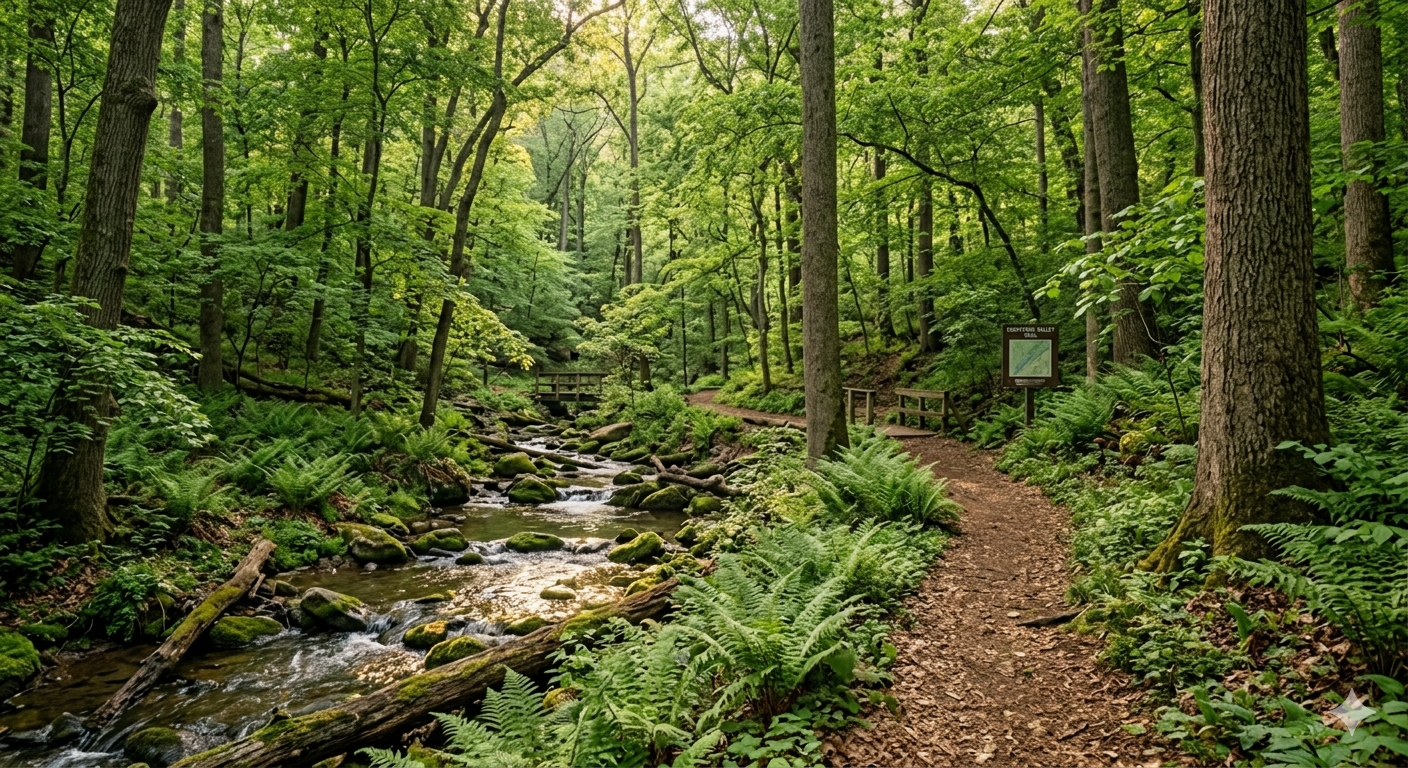
Soapstone Valley Park runs through the heart of Forest Hills, connecting residents to Rock Creek Park and offering the kind of natural access buyers rarely find this close to the city center.
Frequently Asked Questions About Living in Forest Hills, DC
Where exactly is Forest Hills in Washington, DC?
Forest Hills is in the northwest quadrant of Washington, DC. It is bounded by Connecticut Avenue NW to the west, Rock Creek Park to the east, Chevy Chase DC and Maryland to the north, and Tilden Street NW to the south. It sits directly north of Cleveland Park and south of the DC-Maryland border, placing it in upper Northwest DC alongside other desirable neighborhoods like Chevy Chase DC and North Cleveland Park.
Why is Forest Hills sometimes called Van Ness?
The neighborhood is frequently referred to as Van Ness because of its proximity to the Van Ness-UDC Metro station on the Red Line and the Van Ness campus of the University of the District of Columbia. The two names are often used interchangeably by residents and in real estate listings, and both refer to the same geographic area.
What types of homes are available in Forest Hills, DC?
Forest Hills offers genuine variety. Detached single-family homes on generous lots represent the signature property type, ranging from traditional colonials and Tudors to distinctive modernist and contemporary designs. Mid-century cooperative and condominium buildings along Connecticut Avenue provide more accessible price points. The neighborhood is notably free of the dense townhouse development that characterizes many other DC neighborhoods, which preserves its residential scale.
What are the schools like in Forest Hills?
Public school options include Murch Elementary, Deal Middle School, and Jackson-Reed High School, all of which are well-regarded within the DC public school system. School boundary assignments and program offerings change; buyers should verify current information directly with DC Public Schools before making decisions based on school access. Results in any real estate transaction vary depending on the property, timing, and market conditions; no specific outcome is guaranteed. The Edmund Burke School provides an independent high school option within the neighborhood. Maret, National Cathedral, St. Albans, and Washington International School are nearby private options as well.
Is Forest Hills a walkable neighborhood?
It depends on what you are walking to. Connecticut Avenue is highly walkable, with restaurants, cafes, a grocery store, and the Metro station all within easy reach. The interior residential streets and park paths are wonderful for walking, running, and dog walks. For daily errands and dining, residents rate walkability highly. For major shopping or entertainment outside the immediate area, a Metro or car is typically needed.
What is the commute like from Forest Hills to downtown DC?
The Van Ness-UDC Metro station on the Red Line puts residents roughly 20 to 25 minutes from downtown offices during rush hour. Connecticut Avenue also provides a direct driving route. Residents who work in Bethesda or points north on the Red Line are equally well positioned. For a neighborhood that feels as residential and removed as Forest Hills does, the commute times to major employment centers are genuinely competitive.
Are there parks and trails near Forest Hills?
Yes, and this is one of the neighborhood’s most distinctive features. Rock Creek Park borders the entire eastern edge of Forest Hills, providing immediate access to hundreds of acres of wooded trails, biking paths, and open space managed by the National Park Service. Soapstone Valley Park runs through the neighborhood’s interior along a wooded stream trail that connects to the Rock Creek system. Few DC neighborhoods offer this level of natural access.
What makes Forest Hills different from Cleveland Park or Chevy Chase DC?
Forest Hills tends to offer larger lots, more architectural variety, and deeper park integration than Cleveland Park. Compared to Chevy Chase DC, it has a more wooded, less manicured character, with more winding streets and topographic variation. It also carries a distinct international and institutional character, driven by the embassy presence, Howard University School of Law, and community institutions like the Levine School of Music. Buyers who have toured all three typically find that Forest Hills appeals to those who want something a degree more private and architecturally interesting than its neighbors.
A Neighborhood That Holds Its Value
Forest Hills is not a neighborhood that needs to be sold. Buyers who discover it tend to feel the pull immediately. The combination of space, nature, architecture, and genuine community character is rare in any city, and especially rare within a reasonable commute of one of the country’s major employment centers.
What changes is the market context, and in 2026 that context rewards buyers who are prepared, informed about the specific micro-market dynamics here, and working with an agent who knows which properties represent genuine value and which ones are priced on hope rather than data.
With over $780 million in career sales volume and 23+ years working in DC, Maryland, and Virginia, I work with buyers and sellers in Forest Hills and across upper Northwest DC on a regular basis. If you are thinking about buying here or exploring what the neighborhood can offer your household specifically, I am happy to have that conversation without pressure or obligation.
Contact Matt directly for a current market analysis and to discuss buyer strategy specific to Forest Hills.
About Matt Cheney
Matt Cheney is a top-producing real estate advisor with Compass in Washington, DC, guiding buyers and sellers across DC, Maryland, and Virginia through high-stakes moves, from luxury sales to estate settlements, downsizing, and divorce-related transactions. With over $780 million in career sales volume and 23 years of experience, Matt is ranked in the Top 1.5% of agents nationally by RealTrends America’s Best. He is known for calm, strategic guidance and a straightforward approach to complex and sensitive real estate situations.
Matt Cheney | Compass Real Estate is committed to the principles of the Fair Housing Act and the Equal Opportunity Act. All real estate services are provided without regard to race, color, national origin, religion, sex, familial status, or disability.
Real estate considerations related to divorce or estate matters involve legal and financial complexities. Consult a qualified attorney and financial advisor for guidance specific to your situation.