


The right real estate advisor for an empty nester downsize in the DC metro area brings current local expertise, genuine life-stage experience, and a communication style that makes a high-stakes transition feel manageable.
You have spent weeks, maybe months, talking about the move. The house is too large. The maintenance is more than you want. The next chapter is calling. And somewhere in the middle of those conversations, the question surfaces: who do we actually call?
Not just any agent. The right one. Someone who has done this before, who knows what it looks and feels like to help a family sell a home they have lived in for twenty years, navigate the emotional weight of that decision, and land them in a property that fits where they are now rather than where they were then.
Finding that advisor is not as simple as calling the agent who sold you the house, looking up whoever has the most yard signs in the neighborhood, or picking someone from an internet search result. The right real estate advisor for an empty nester downsizing in Washington, DC, Bethesda, McLean, Chevy Chase, or anywhere across the DC metro area is someone with a specific combination of experience, local market knowledge, and personal approach that is worth taking the time to identify carefully.
This guide explains exactly what to look for, what questions to ask, what red flags to watch for, and how to evaluate whether a specific advisor is genuinely the right fit for one of the most significant financial and personal transitions you will make.
Why the Right Advisor Matters More for Downsizing Than for a Typical Sale
Downsizing from a long-held family home is categorically different from a typical real estate transaction in ways that matter for how you choose your advisor.
It is not simply a sale. It is a life transition. The home you are selling carries decades of memory and meaning. The decision of when to move, where to go, and how to navigate the process involves emotional dimensions that most financial transactions do not. An advisor who treats it like a commodity sale, who moves fast, talks past the emotional weight of the decision, and focuses exclusively on the transaction mechanics, will leave you feeling unheard and unsupported at a moment when support matters.
It also involves more complexity than a standard sale. Long-held DC metro homes often carry significant capital gains exposure that affects the timing and structure of the sale. The physical preparation of a home that has been occupied for fifteen to twenty-five years requires more planning and lead time than a home that was purchased and staged more recently. The coordination between selling the current home and purchasing the next one, whether simultaneously or in sequence, requires careful orchestration that inexperienced advisors handle poorly.
And the financial stakes are genuinely high. Empty nesters in Bethesda, McLean, Spring Valley, Potomac, and Chevy Chase are often managing $800,000 to $2 million or more in equity. The difference between a strong advisor who positions the property correctly, prepares it strategically, and negotiates with discipline, and an average one who underprices or mis-times the listing, can easily reach $50,000 to $150,000 in final net result. At that level of financial consequence, who you work with is not a minor decision.
What to Look for in a Real Estate Advisor for Empty Nester Downsizing
Deep and Current Local Market Knowledge
The DC metro area is not one market. It is dozens of micro-markets operating simultaneously, each with its own inventory dynamics, buyer profiles, pricing patterns, and seasonal rhythms. An advisor who works across the entire metro area at low volume has surface-level familiarity with many neighborhoods and deep knowledge of none of them.
The advisor you want for a downsizing sale in Bethesda, Chevy Chase, Northwest DC, McLean, or Arlington should be able to tell you, from firsthand experience, what comparable homes in your specific neighborhood have sold for in the past six months, how long they stayed on the market, what buyers in your price range are currently prioritizing, and what the specific characteristics of your property mean for positioning and price. That level of knowledge only comes from consistent, high-volume activity in the neighborhoods that matter to you.
Ask any advisor you are considering: how many homes have you sold in my specific neighborhood in the past twelve months? What were the sale prices and days on market? What is the current inventory and buyer demand picture for homes like mine? If the answers are vague, general, or hedged, that tells you something important about the depth of their local knowledge.
Proven Experience With Life-Stage and Transition Sales
Not every agent who has completed many transactions has extensive experience with the specific dynamics of empty nester and life-stage sales. These transactions are different in character from a young couple’s first purchase or a move-up buyer’s trade. They involve more preparation time, more emotional complexity, more physical sorting and decision-making, and often more coordination between the real estate transaction and broader financial planning.
Look for an advisor who can speak fluently and specifically about downsizing experience. Not just that they have done it, but how they approached it. How did they help the seller decide what to do to the home before listing? How did they handle the emotional dimensions of the process? How did they coordinate the sale with the client’s purchase of the next property? How did they manage a situation where the seller was not quite ready emotionally even when they were logistically ready to list?
An advisor who has navigated this terrain many times will answer those questions with stories and specifics. One who has not will answer with generalities.
A Track Record That Demonstrates Consistent Performance
Credentials and designations are useful but insufficient on their own. What matters most is a verifiable track record of strong performance at your price point, in your market, across market conditions.
Look for an advisor who ranks consistently among the top producers in your area, not just in a single exceptional year but across multiple years. In the DC metro market, meaningful benchmarks include ranking in the top tier of agents nationally through programs like RealTrends, consistent volume and transaction count data, and a client base that generates significant referral and repeat business.
Referral-driven business is one of the most telling signals of advisor quality. An advisor whose clients return for their next transaction and send their friends, family members, and colleagues is an advisor who consistently delivers an experience that earns that trust. Ask any advisor you interview what percentage of their business comes from referrals and repeat clients. The answer is one of the most honest measures of client satisfaction available.
Total career sales volume is another meaningful data point. An advisor with $700 million or more in career sales across DC, Maryland, and Virginia has navigated a volume and variety of transactions that produces judgment and pattern recognition no newer agent can replicate, regardless of how enthusiastic or attentive they are.
A Communication Style That Matches How You Process Decisions
The technical competence of an advisor matters. So does their personality and communication style, because you will be working closely with this person through a process that involves both pressure and emotion.
The advisor who works best for most empty nester clients in the DC metro area is someone who communicates clearly without condescension, gives honest assessments rather than telling you what you want to hear, moves at a pace that respects your timeline rather than pushing for speed that serves their schedule, and brings a calm, steady presence to moments that feel uncertain or stressful.
Advisors who are highly transactional in their approach, who push hard for fast decisions, who minimize the emotional dimensions of the sale, or who are difficult to reach when you have questions, are not the right fit for a life-stage transition. Pay attention to how an advisor communicates from the very first conversation. Their responsiveness, their listening, and their honesty in that initial meeting are strong predictors of how they will show up throughout the process.
A Network of Trusted Supporting Professionals
A downsize is rarely just a real estate transaction. It involves estate attorneys, CPAs, financial advisors, home inspectors, contractors, painters, stagers, movers, estate sale companies, and often other professionals whose work directly affects the quality of the overall outcome.
An experienced, well-connected local advisor brings a vetted network of these professionals to the engagement. They know which inspector is thorough and fair. Which painter does excellent work on older DC metro homes. Which stager understands how to present a traditional family home to today’s buyers. Which estate sale company handles a decades-long household of belongings with care and efficiency.
That network is a practical asset that saves you time, reduces decision fatigue, and improves the quality of every step in the process. An advisor who has been active in the DC metro market for two decades has built those relationships through experience. An advisor who is newer to the market or the area is building them alongside you, which is a meaningful difference when the stakes are high.
Red Flags to Watch for When Interviewing Real Estate Advisors
Knowing what to look for is one side of the evaluation. Knowing what to avoid is equally important.
Be cautious of advisors who suggest an unusually high list price without specific data to support it. This practice, sometimes called buying a listing, is a short-term strategy that tends to produce longer days on market, eventual price reductions, and a final sale price below what a correctly priced home would have achieved. Any advisor who suggests a price significantly above what comparable sales support should be able to defend that recommendation with specific, current data. If they cannot, treat the number as a sales tactic rather than a professional assessment.
Be cautious of advisors who minimize the preparation conversation. A home that has been lived in for fifteen to twenty years almost always requires some level of cleaning, updating, and staging before it is ready to compete effectively in the DC metro market. An advisor who tells you the home is fine as-is without walking through it carefully, or who is not willing to have an honest conversation about what buyers in your price range currently expect, is not prioritizing your outcome.
Be cautious of advisors who are not familiar with the specific financial dimensions of downsizing sales, including capital gains considerations, net proceeds modeling, and the tax differences between DC, Maryland, and Virginia. You do not need your real estate advisor to be a CPA, but they should be fluent enough in these topics to have an intelligent conversation and to connect you with the right resources when deeper expertise is needed.
Be cautious of advisors who have difficulty naming specific recent sales in your neighborhood or who cannot describe the current buyer profile for homes at your price point. Vague or general answers to specific local market questions suggest a lack of the firsthand knowledge that your transaction requires.
Be cautious of advisors who are visibly eager to close quickly at any cost. Speed is appropriate when the market and your situation call for it. It is not appropriate as a default approach when you are navigating a transition that deserves care, preparation, and timing that serves your interests rather than the advisor’s schedule.
The Questions to Ask Before You Choose a Real Estate Advisor
The interview process with a real estate advisor is more than a formality. It is a genuine evaluation, and the questions you ask will tell you as much as the answers you receive. Here is a set of questions specifically relevant to empty nester downsizing in the DC metro market.
How many homes have you sold in my specific neighborhood in the past twelve months, and at what price points? This question tests the depth of their current local knowledge. A strong answer includes specific addresses or price ranges with context. A weak answer generalizes to the broader area.
What do you see as the primary buyer profile for a home like mine in today’s market? This tests their understanding of current buyer demand, not just historical patterns. A strong answer describes who is actively buying at your price point and what they are prioritizing.
How do you approach the pre-listing preparation process for a home that has been owner-occupied for fifteen to twenty years? This tests their experience with the specific dynamics of long-held family home sales. A strong answer involves a walkthrough process, a prioritized improvement plan, and specific knowledge of which investments pay off in your market.
What is your experience with the capital gains and financial planning dimensions of downsizing sales? This tests their financial fluency. A strong answer acknowledges the importance of these considerations, outlines how they discuss them with clients, and explains how they coordinate with tax and financial advisors when needed.
How do you handle the emotional dimensions of selling a long-held family home? This question reveals their awareness of and sensitivity to the personal weight of the transition. A strong answer demonstrates that they have navigated this before and understand that the process is about more than the transaction mechanics.
What percentage of your business comes from referrals and repeat clients? This is among the most revealing questions you can ask. An advisor whose business is predominantly referral-driven has built their practice on client satisfaction rather than marketing spend. That signal is hard to manufacture.
Can you walk me through a recent downsizing transaction you handled in my area? This tests whether their experience is real and specific. A strong answer includes enough detail about the property, the preparation process, the pricing strategy, and the outcome to demonstrate genuine familiarity with the type of transaction you are considering.
How will you communicate with me throughout the process, and how quickly do you typically respond to calls or messages? This practical question reveals whether their communication style and availability match your needs. The answer matters less than whether their behavior in the interview itself already demonstrates what you need.
The Role of Credentials and Designations: Useful Context, Not the Full Picture
You will encounter various credentials and designations as you research real estate advisors in the DC metro area. These are worth understanding, though they are better used as context than as primary selection criteria.
The Seniors Real Estate Specialist designation, known as SRES, is offered through the National Association of Realtors and is specifically designed for agents working with clients aged 50 and older. Holders have completed training on the specific financial, emotional, and lifestyle considerations of mature homeowners. It is a relevant and useful credential for empty nester clients.
The Certified Residential Specialist designation, or CRS, indicates an agent who has met specific production and education requirements and is generally associated with higher-volume, more experienced practitioners.
The Accredited Buyer’s Representative designation, known as ABR, is relevant if your advisor will also be helping you purchase your next home, which in a downsizing transition is typically the case.
Rankings from third-party organizations like RealTrends America’s Best, which identifies the top 1.5 percent of agents nationally based on transaction volume and performance, are meaningful benchmarks because they are based on verifiable production data rather than self-reported achievement. An advisor who has consistently ranked in the top tier nationally has a track record that independent data supports.
Credentials are a useful starting point for filtering, but they should be paired with specific local transaction history, client references, and the quality of the conversation you have with the advisor in person. A designation alone does not tell you whether someone is the right fit for your specific situation in your specific neighborhood.
How to Find Candidates for Your Advisor Search in the DC Metro Area
Referrals from people whose judgment you trust remain the most reliable starting point for finding a real estate advisor. When a friend, colleague, or neighbor in Bethesda, McLean, or Northwest DC tells you that a specific advisor handled their downsizing transition thoughtfully and produced a strong result, that firsthand recommendation carries more weight than any advertisement or review platform.
Ask your professional network, particularly people in similar life stages who have completed a downsizing move in the DC metro area in recent years. Ask your financial advisor or CPA, who likely has relationships with real estate professionals they trust based on the quality of the work they have observed in transactions. Ask your estate attorney if you have one.
Online research is useful for building a candidate list and reviewing public information about an advisor’s production history. Platforms like Zillow, Realtor.com, and Google provide client reviews that, when read carefully and in aggregate, reveal patterns about an advisor’s communication style, reliability, and approach. Look for reviews that speak specifically to the downsizing or life-stage experience rather than generic praise.
Compass Real Estate’s platform provides detailed agent production data that allows you to evaluate transaction history, neighborhood expertise, and price point concentration before you reach out. That transparency is useful when building your candidate list.
Attend open houses in your target neighborhood or target price range for your next home. Observing an advisor in their professional environment, how they present a property, how they interact with visitors, how they answer questions, gives you data that no profile page can replicate.
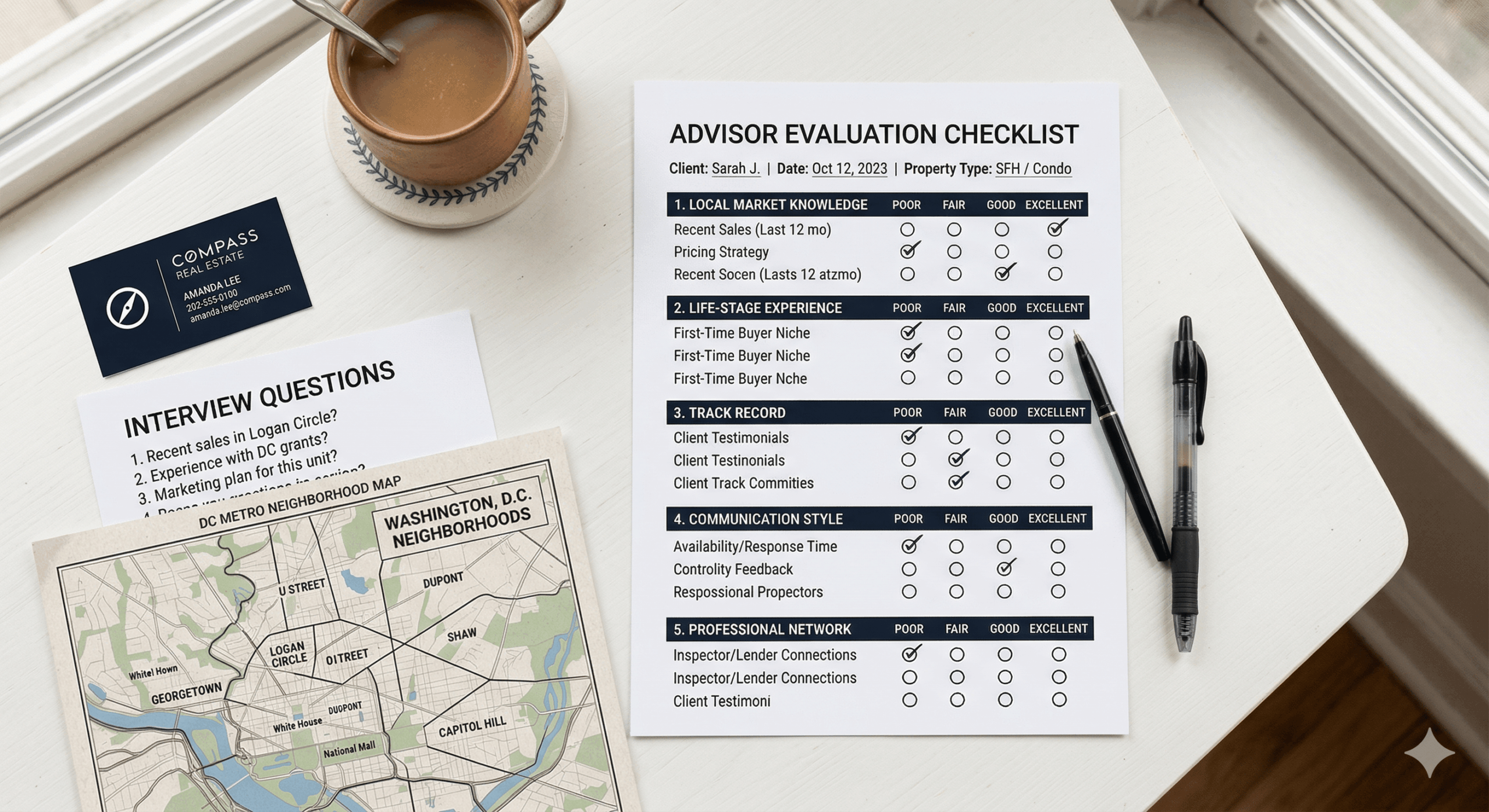
Choosing the right real estate advisor for a downsizing sale in the DC metro area deserves the same care and evaluation as the financial decisions that follow from it.
Why Experience in the DC Metro Area Specifically Is Non-Negotiable
The Washington, DC metro area real estate market has characteristics that make local expertise a genuine necessity rather than a preference.
The jurisdictional complexity alone is significant. DC, Maryland, and Virginia each have distinct transfer tax structures, contract forms, disclosure requirements, settlement customs, and timeline norms. An advisor who primarily works in one jurisdiction but not the others may be genuinely unfamiliar with the nuances of a transaction in a neighboring market. For empty nesters who are selling in one jurisdiction and buying in another, that cross-jurisdictional fluency matters.
The neighborhood-level variation in the DC metro area is as dramatic as in any market in the country. The difference between what a home in Chevy Chase, DC commands versus Chevy Chase, Maryland, or what drives value in Spring Valley versus Foxhall, or how the buyer profile in Potomac differs from the buyer profile in Great Falls, requires local knowledge that only comes from sustained, high-volume work in those specific communities.
The relationship dynamics of the DC metro market also reward local credibility. Experienced local agents know each other, know what off-market opportunities look like, know which listing agents are easy to work with and which are not, and bring to every transaction a network of relationships that directly affects the quality of the outcome. That relational capital is built over time in a specific market. It does not transfer from elsewhere.
What the Right Advisor Conversation Feels Like
After more than two decades of working with empty nesters across Washington, DC, Maryland, and Virginia, I can tell you that the right advisor conversation has a distinct quality that is recognizable even before a single piece of data is shared.
It feels like being heard. The advisor asks about your situation, your timeline, your concerns, and your goals before they start talking about what they can do for you. They listen more than they speak in the first thirty minutes. They ask follow-up questions that reveal they are paying attention to your specific circumstances rather than running through a script.
It feels honest. The advisor tells you things you may not want to hear, the realistic value range for your home rather than the aspirational one, the preparation work that actually needs to happen before you list, the timeline that reflects reality rather than your preferred schedule, because they know that honesty now produces better outcomes than flattery later.
It feels calm. A large, experienced advisor does not need to impress you with urgency or performance. They know the market, they know the process, and they carry a steadiness that is reassuring rather than unsettling. You leave the conversation feeling more clear about the decision ahead, not more anxious.
And it feels like a partnership. The right advisor is not someone who does things to you or for you. They are someone who works with you through a process that will require both of you to be at your best. That partnership quality is visible from the very first conversation.
Why DC Metro Empty Nesters Choose Matt Cheney at Compass
Over 22 years and more than $779 million in career sales across Washington, DC, Maryland, and Virginia, a significant portion of that work has been with empty nesters navigating the exact transition described in this guide. Selling a family home in Bethesda, Chevy Chase, McLean, Northwest DC, Arlington, Potomac, or Great Falls after twenty or more years of ownership. Navigating the emotional weight of that sale with patience and honesty. Building a preparation strategy that positions the home to achieve its strongest possible result. Coordinating the sale with a next-chapter purchase that fits the life the client actually wants to live.
Being ranked among the top 1.5 percent of agents nationally by RealTrends is the result of consistent performance across market cycles, not exceptional results in a single favorable year. That consistency is what clients in the DC metro area rely on when they are navigating a transition where the financial stakes are high and the personal weight is real.
The business is predominantly referral-driven, which means that the clients who come through the door almost always arrive because someone they trust recommended this work specifically for a situation like theirs. That pattern of referral is the most honest measure of client experience available, and it is the one that matters most.
If you are an empty nester in the DC metro area thinking about a downsize or move and want to understand what the process looks like, what your home is worth in today’s market, and what a partnership with a trusted local advisor would feel like, the right starting point is a conversation. It costs nothing. It takes about an hour. And it almost always produces significantly more clarity than anything you will find in a search result.
Frequently Asked Questions About Finding a Real Estate Advisor for Downsizing in DC, Maryland, and Virginia
What should I look for in a real estate advisor who specializes in empty nester downsizing in the DC area?
Look for deep and current local market knowledge in your specific neighborhood, demonstrated experience with life-stage and transition sales specifically, a consistent production track record at your price point, a communication style that matches how you process decisions, and a vetted professional network that supports every step of the transition. The combination of those qualities, not any single credential, defines the right fit for a downsizing sale in the DC metro area.
How do I know if a real estate advisor has enough experience with downsizing sales in DC, Maryland, or Virginia?
Ask them directly and specifically. How many downsizing transitions have they navigated in the past three years? Can they walk you through a specific recent example? How do they approach the preparation process for a long-held family home? What is their experience with the capital gains and financial planning dimensions of these sales? Strong answers will be specific, grounded in real transactions, and demonstrate awareness of the unique dimensions of life-stage sales. Vague or general answers suggest experience that does not match the specificity of the question.
Is the SRES designation important when choosing a real estate advisor for downsizing?
The Seniors Real Estate Specialist designation signals training in the specific financial and lifestyle considerations of clients aged 50 and older, which is relevant context. It is a useful starting point for filtering candidates, but it should be paired with a verified local transaction history, client references, and the quality of the conversation you have in person. A designation without consistent local production and a genuinely good fit in communication style and approach will not produce the outcome you need.
Should I work with the same agent who sold me my current home when downsizing in the DC area?
Not necessarily. The agent who sold you your home years ago may have been excellent at that time and in that market condition. But real estate performance is current and local, and the right question is whether they have consistent, recent, high-volume experience with downsizing sales at your price point in your specific neighborhood today. If the answer is yes, continuity of relationship has real value. If their experience has moved in a different direction, the right fit for your downsizing sale may be someone different.
How many advisors should I interview before choosing one for my downsizing sale?
Two to three advisors is generally the right range for a downsizing sale in the DC metro area. Fewer than two means you may not have enough comparison points to make a fully informed evaluation. More than three tends to produce decision fatigue and information overload that actually makes the choice harder. Interview each one with the same questions so you can make a direct comparison. Pay as much attention to how they make you feel in the conversation as to what they say in it.
What is the difference between a real estate agent and a real estate advisor for a downsizing sale?
In practical terms, the distinction is about approach rather than licensing. Every real estate advisor holds a license and is governed by the same professional standards. The difference is in how they engage with clients and define their role. A transactional agent focuses primarily on completing the transaction. An advisor engages more broadly with the client’s goals, situation, and the full context of the decision, bringing financial fluency, preparation guidance, and strategic thinking alongside the transaction management. For a downsizing sale in the DC metro area where the financial and personal stakes are high, an advisor approach is almost always the better fit.
How do I verify that a real estate advisor’s track record is as strong as they say?
Ask for verifiable production data. Transaction counts, sale prices, days on market, and neighborhoods where they have been active are all data points that can be verified through public records and MLS history. Third-party rankings from organizations like RealTrends America’s Best are based on independently verified production data rather than self-reported achievement and are a meaningful signal. Client references from downsizing transactions specifically, not just general sales references, are also appropriate to request and worthwhile to follow up on.
What is the biggest mistake empty nesters make when choosing a real estate advisor for a downsize in DC, Maryland, or Virginia?
The most common mistake is choosing based on familiarity rather than fit. Selecting the agent whose name appears most often on yard signs, or who someone in a social network mentioned casually, or who called first, without evaluating whether they have the specific experience, local knowledge, and personal approach that a downsizing transition requires. The second most common mistake is choosing based on the highest suggested list price rather than the strongest overall case for how they will position and sell your home. Both mistakes have meaningful financial consequences in a market where the right advisor outperforms the average one by tens of thousands of dollars in net result.
A Final Word on Choosing Who Guides You Through This
The advisor you choose for a downsizing sale in the DC metro area is not just someone who fills out paperwork and puts a sign in your yard. They are the person who helps you understand what your home is truly worth today, who builds the preparation strategy that positions it to sell at the strongest possible number, who negotiates your contract and manages your timeline with discipline, and who guides you through the emotional and logistical complexity of a transition that is both significant and irreversible.
That person deserves to be chosen carefully. With questions rather than assumptions. With comparison rather than convenience. With an eye toward who has genuinely done this before, at this level, in this market, and who brings to the conversation the honesty, the expertise, and the calm that a decision this important deserves.
The right conversation changes everything about how the process ahead feels. If you are thinking about a downsize or move in Washington, DC, Maryland, or Virginia and want to have that conversation with someone who has been here before, the door is open.
About Matt Cheney
Matt Cheney is a top-producing real estate advisor with Compass in Washington, DC, guiding buyers and sellers across DC, Maryland, and Virginia through high-stakes moves, from luxury sales to estate settlements, downsizing, and divorce-related transactions. With over $779 million in career sales volume and 22 years of experience, including more than two decades working on complex and sensitive real estate situations, Matt is known for calm, strategic guidance and brings hundreds of successful sales to clients seeking clarity and support during life transitions.