

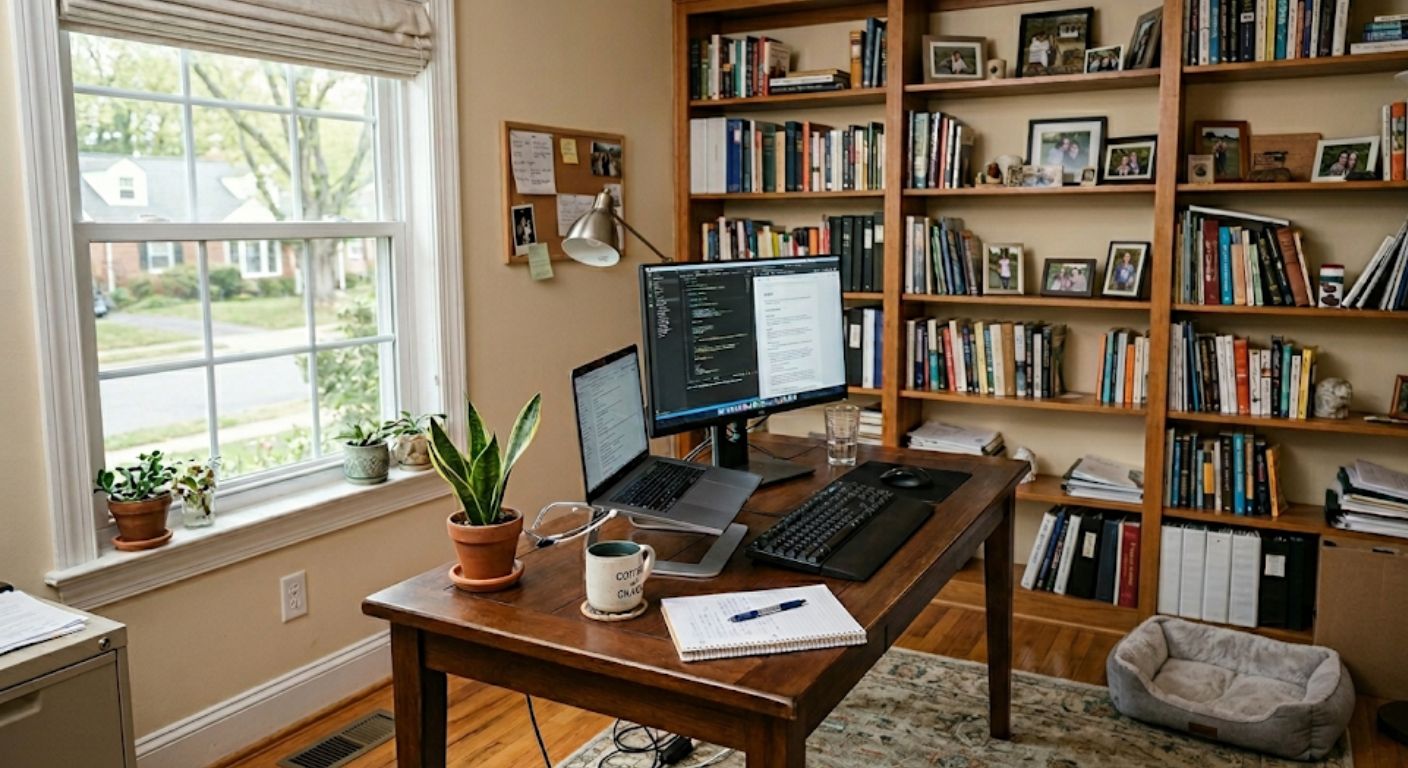
When you work from home most of the time, the home itself functions differently. That changes what to look for in a DC metro area home search.
Remote Work Has Changed What Buyers Are Actually Looking For
For buyers who work from home most or all of the time, the home functions differently than it did for previous generations of buyers. The commute question, which used to shape where people looked and what they were willing to compromise on, has changed significantly. And that shift has real implications for how remote workers should approach a home search in the DC metro area.
This isn’t about finding a “remote worker home.” It’s about understanding which features and trade-offs matter differently when the home is also your workplace, and making sure the search reflects that.
Rethinking the Commute Trade-Off
In a traditional search, proximity to downtown DC, Metro access, and commute time to an employer’s office were often the primary filters. For fully remote workers, that calculation changes entirely. Location matters for different reasons: proximity to things you use in daily life, neighborhood character, outdoor access, and the general livability of where you’ll be spending most of your time.
For hybrid workers who go into an office a few days a week, the calculus is somewhere in between. A 40-minute drive or Metro ride might feel entirely manageable two or three days a week when it would have been prohibitive five days a week. That means some neighborhoods and price points that previously felt too far out may now make sense.
Worth noting: workplace policies change. If your remote arrangement could shift in the next few years, buying with the assumption that commute will never matter again is a risk worth thinking through honestly.
What to Prioritize in the Floor Plan
For remote workers, a dedicated, functional work space in the home tends to move up the list of priorities significantly. An extra bedroom works fine as an office for some people. For others, the door, the layout, the noise level from the rest of the house, and access to natural light all matter quite a bit.
Think about what your actual workday looks like. Do you have frequent video calls where background and acoustics matter? Do you need a space where you can close a door during working hours? Is your work style better supported by a quiet, separate room or by being integrated into the main living space?
Buyers who prioritize a dedicated work space often find themselves weighing a smaller home with the right room configuration against a larger one that doesn’t quite have what they need. That’s a real trade-off and there’s no universal answer, but it’s one to think through before you start touring rather than after.
Infrastructure and Connectivity
Reliable internet is not optional when you work from home. Before making an offer on a property, it’s worth verifying what service providers cover that address and what speeds are actually available, not just advertised in the area. Coverage can vary significantly even within the same neighborhood, and some older buildings and areas in DC and Maryland have meaningful connectivity limitations.
In most of DC and the closer-in suburbs, reliable high-speed internet is broadly available. Further out in parts of Maryland and Virginia, it’s worth checking more carefully. Your agent can help flag this if it’s a concern.
Also worth thinking about: cell reception inside the home. Some older buildings and homes in DC have poor interior reception, which matters if you’re frequently on calls without Wi-Fi calling.
You may also like: The Best Suburban Walkable Downtowns in Maryland and Virginia, Best Neighborhoods for Newly Married Couples in DC, Maryland, and Virginia, and 5 of Washington DC’s Most Walkable Neighborhoods for Everyday Living
Neighborhood Character Matters More When You’re There All Day
Buyers who are in the office five days a week might not notice whether the neighborhood feels right during the day because they’re rarely there. Remote workers are home most of the time, which means the feel of the neighborhood during a Tuesday afternoon matters in a way it doesn’t for a commuter.
Some things worth paying attention to: how quiet is the street during working hours? Is there access to parks, trails, or green space for a midday break? Are there coffee shops or libraries within reasonable distance if you occasionally want to work somewhere else? How does the neighborhood feel in different seasons?
These aren’t questions you can answer fully from a Saturday afternoon showing. Walking or driving through at different times of day and week, and talking to your agent about the neighborhood’s general character, gives you a more accurate picture.
Outdoor Space and the Home as a Full-Time Environment
Buyers who were previously home primarily in the evenings and on weekends sometimes find, after they transition to remote work, that the outdoor space and overall livability of the home matter more than they anticipated. A yard or outdoor area that felt like a nice bonus becomes something used daily.
In the DC metro area, homes with usable outdoor space vary considerably by neighborhood and price point. Urban DC properties tend toward smaller lots or no outdoor space at all. Moving to areas like Chevy Chase, Bethesda, Alexandria, or further out into Maryland or Northern Virginia often means more outdoor space, which some remote workers find genuinely valuable once they’re home full-time.
The Financial Picture for Remote Workers
If you work remotely for a company headquartered outside the DC area, or if your income comes from freelance or consulting work, the income documentation process during mortgage underwriting can look slightly different than it does for a W-2 employee. Having clear documentation of your income, your employment status, and the stability of your remote arrangement is worth preparing before you start making offers.
Lenders are generally comfortable with remote work at this point, but the specifics of how your income is structured matter. Talk to a lender early in the process so you understand exactly what you’ll need to document.
Frequently Asked Questions About Buying in DC as a Remote Worker
Does working remotely change what neighborhoods I should consider in DC?
It can, significantly. Without a daily commute driving your decisions, you can expand your geographic range and prioritize neighborhoods based on livability, outdoor access, lot size, and general character rather than Metro proximity alone. The right neighborhood depends on your lifestyle priorities and how often you expect to come into the city.
What should I look for in a floor plan as a remote worker?
A dedicated room that can function as an office is high on most remote workers’ lists, particularly one with good natural light and acoustic separation from the main living areas. Beyond that, the specific priorities depend on how you work, whether you have frequent video calls, and how important it is to fully close off the work space at the end of the day.
Is internet connectivity something I should verify before making an offer?
Yes. In most of DC and close-in suburbs it’s not an issue, but it’s always worth confirming that reliable high-speed service is available at the specific address. Your agent can help you think through how to verify this.
Do lenders treat remote workers differently in the mortgage process?
Not necessarily, but how your income is structured and documented matters. W-2 remote employees generally go through the same process as any other employee. Freelancers or contractors may need to document income over a longer period. Getting pre-approved early lets you understand exactly what will be required for your situation.
About Matt Cheney
Matt Cheney is a top-producing real estate advisor with Compass in Washington, DC, guiding buyers and sellers across DC, Maryland, and Virginia through high-stakes moves, from luxury sales to estate settlements, downsizing, and divorce-related transactions. With over $779 million in career sales volume and 22+ years of experience, Matt is ranked in the Top 1.5% of agents nationally by RealTrends America’s Best. He is known for calm, strategic guidance and a straightforward approach to complex and sensitive real estate situations.
Matt Cheney | Compass Real Estate is committed to the principles of the Fair Housing Act and the Equal Opportunity Act. All real estate services are provided without regard to race, color, national origin, religion, sex, familial status, or disability.