

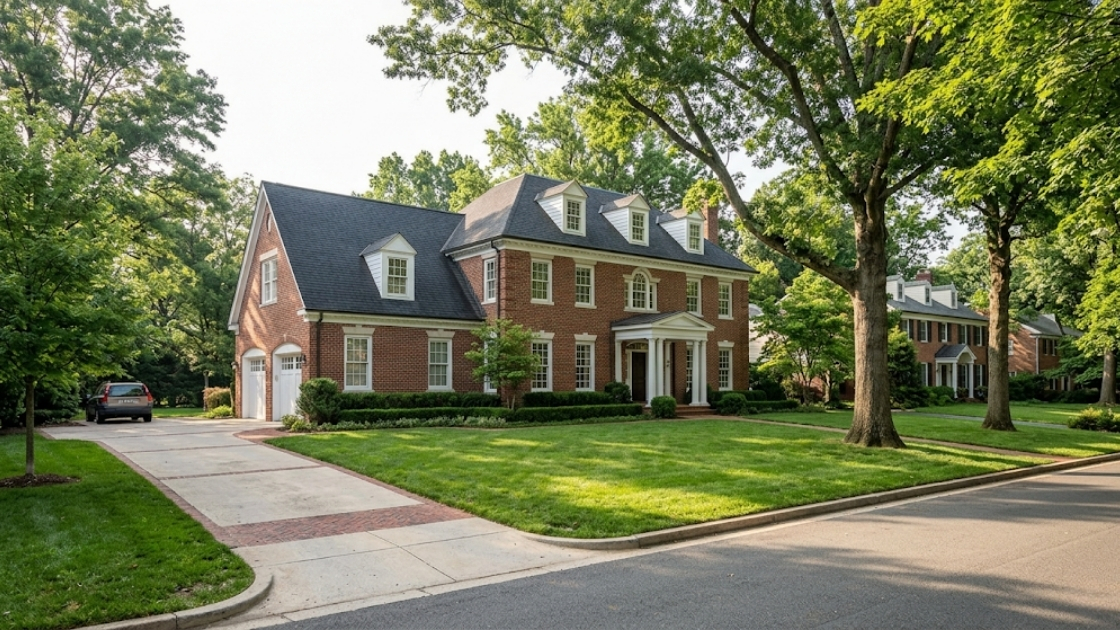
Spring Valley is one of Northwest DC’s quieter success stories. It does not get the national name recognition of Georgetown or the constant media coverage of Chevy Chase, but among buyers who know the DC market well, Spring Valley carries serious appeal. The homes are substantial, the lots are generous by city standards, and the neighborhood has a residential feel that is hard to find this close to the center of Washington.
If you are thinking about buying in Spring Valley, here is what is worth knowing before you start touring.
What Spring Valley DC Actually Looks Like
Spring Valley sits in the upper reaches of Northwest DC, roughly bounded by Massachusetts Avenue, the DC-Maryland line, and Nebraska Avenue. The housing stock here skews larger than most of the city, with single-family detached homes on real lots, mature tree canopy, and a general sense of space that buyers coming from denser parts of DC often find surprising.
Architecturally, Spring Valley runs toward Colonial, Tudor, and traditional styles built primarily in the mid-20th century. Many homes have been updated significantly while keeping their original character. You will also find some newer construction and comprehensive renovations that have taken older frames and rebuilt them almost entirely from the inside out.
The neighborhood borders American University to the south, which gives it an institutional anchor and contributes to the steady activity of buyers connected to the university and the broader upper Northwest DC market.
What the Buyer Pool Looks Like in Spring Valley
Spring Valley draws a wide range of buyers. Move-up buyers from smaller Northwest DC homes, buyers relocating from other major cities who want space without immediately going to the suburbs, and buyers specifically seeking larger lots and established landscaping all tend to look here.
The price range in Spring Valley is meaningful. This is not an entry-level market. Buyers need to be prepared for a price point that reflects the lot sizes, home scale, and neighborhood reputation. The good news is that homes here have historically held value well, and the inventory tends to move at a reasonable pace when properties are priced accurately.
What to Look for When Touring Homes in Spring Valley
A few things are worth paying attention to when you are touring in Spring Valley:
- Lot configuration and usable yard space, since lots vary more than they appear to from the street
- Condition of major systems, particularly in homes that have not been recently updated, since some of the mid-century construction can carry deferred maintenance in HVAC, roofing, and plumbing
- Basement quality and finish level, since many Spring Valley homes have significant basement space that adds to usable square footage
- Garage and parking situation, since some lots offer two-car garages and others have more limited configurations
- How the home was renovated, if at all, and whether the updates were done thoughtfully or primarily for a quick flip
Condition matters across all real estate markets, but in a neighborhood where homes were largely built between 1930 and 1960, what has and has not been updated makes a significant difference in what you are actually buying.
How Spring Valley Compares to Nearby Neighborhoods
Buyers often compare Spring Valley to Foxhall, The Palisades, and Chevy Chase DC. Each has its own character, and the right choice depends on what a buyer prioritizes.
Spring Valley tends to offer more lot size and a quieter, more residential feel than some of the busier Foxhall corridors. The Palisades has a different vibe, closer to the river and a bit more removed from main arterials. Chevy Chase DC carries a strong neighborhood identity and a very active buyer market. Spring Valley falls somewhere in the middle, offering size and calm without the extreme remoteness some buyers associate with the far upper Northwest neighborhoods.
How Matt Cheney Helps Buyers in Spring Valley
Matt has worked in Spring Valley and the surrounding Northwest DC neighborhoods for years. The guidance he provides is direct: what is a property actually worth given its condition, configuration, and the current market, and how do you position an offer to compete without overpaying.
With over $779 million in career sales and 22 years of experience across DC, Maryland, and Virginia, Matt brings the kind of neighborhood-specific knowledge that helps buyers move confidently, even in a market where inventory can be limited and competition real.
Frequently Asked Questions
What is the typical price range for homes in Spring Valley DC?
Spring Valley homes generally transact in the upper ranges of the Northwest DC market, with many single-family homes pricing well above $1.5 million and larger, updated properties reaching $3 million or higher depending on condition, lot size, and configuration. The specific range depends on what has been updated and how the home compares to recent comparable sales.
Is Spring Valley a good neighborhood to buy in for long-term value?
Spring Valley has historically been one of the more stable neighborhoods in upper Northwest DC. The combination of lot size, home scale, and location has supported long-term demand. As with any purchase, the right price and condition matter, but the neighborhood fundamentals are solid.
How is parking in Spring Valley DC?
Most Spring Valley homes offer off-street parking, and many have garages. This is one of the practical advantages compared to denser parts of the city. The configuration varies by property, so it is worth confirming during the tour exactly what parking is available and in what condition.
Are there walkability or transit options near Spring Valley?
Spring Valley is a car-dependent neighborhood by DC standards. There is no Metro directly adjacent, though bus service is available and several major routes provide access to the broader city. Buyers coming from denser, more walkable parts of DC should factor this in, particularly if daily commute patterns matter.
Who is the best realtor to help buy a home in Spring Valley DC?
Look for an agent with direct experience in upper Northwest DC, specifically in Spring Valley and the surrounding neighborhoods. The right agent understands which blocks are most active, how to evaluate condition in mid-century construction, and how to position an offer in a competitive situation. Matt Cheney has worked in this part of the market for more than two decades and provides buyers with clear, honest guidance throughout the process.
Final Word
Spring Valley is a neighborhood that rewards buyers who take time to understand it. The homes are substantial, the setting is calm, and the long-term fundamentals are strong. If you are considering Spring Valley as part of your search in upper Northwest DC, a conversation with an agent who knows the neighborhood well is the right first step.
About Matt Cheney
Matt Cheney is a top-producing real estate advisor with Compass in Washington, DC, guiding buyers and sellers across DC, Maryland, and Virginia through high-stakes moves, from luxury sales to estate settlements, downsizing, and divorce-related transactions. With over $779 million in career sales volume and 22 years of experience, including more than two decades working on complex and sensitive real estate situations, Matt is known for calm, strategic guidance and brings hundreds of successful sales to clients seeking clarity and support during life transitions.