

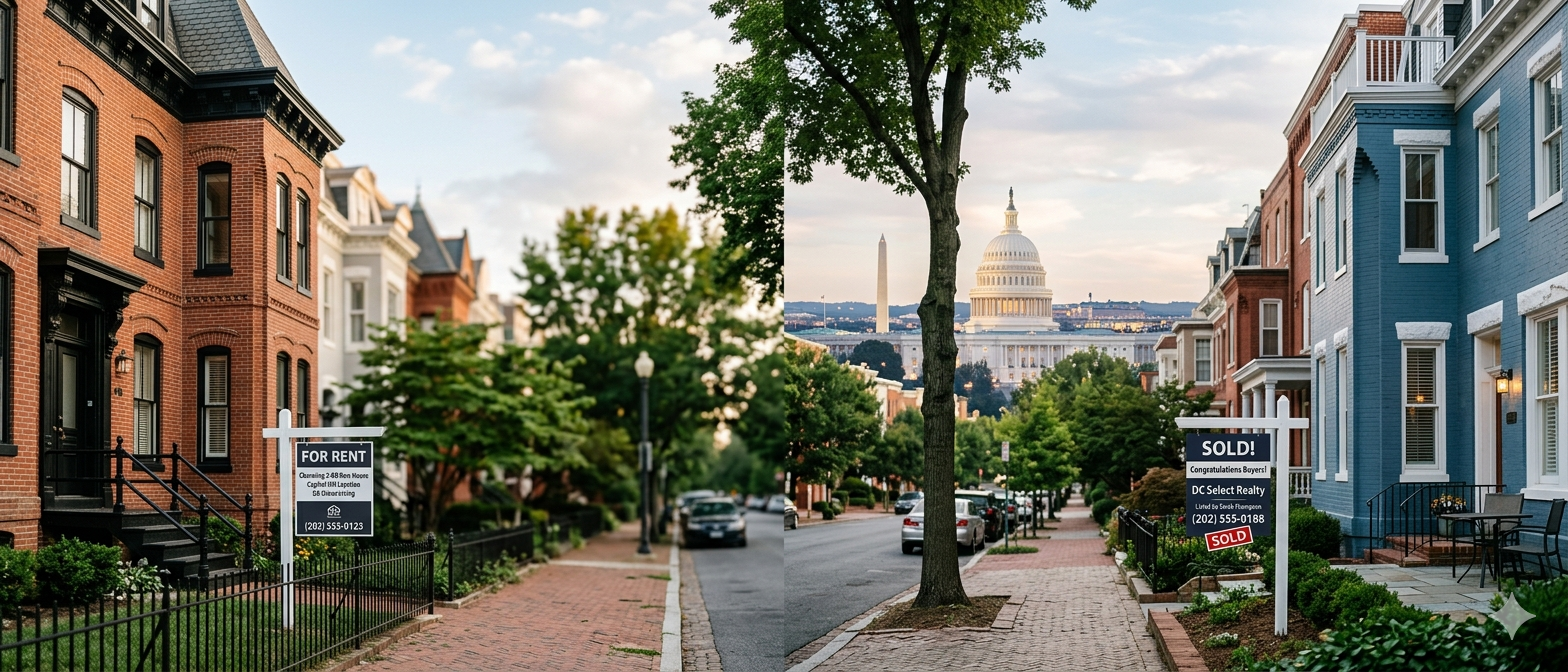
Deciding between renting and buying in Washington, DC? The answer depends on your finances, your timeline, and your life goals. Matt Cheney helps DC area residents make the right move.
If you live in Washington, DC or you are thinking about moving here, one of the first big questions you will face is whether to rent or to buy. It is a question without a single right answer. The Washington, DC metro area is one of the most dynamic housing markets in the country, and the choice to rent or buy depends on your financial situation, your goals, your timeline, and how long you plan to stay.
This guide breaks down the real pros and cons of renting versus buying in Washington, DC and covers what you need to know before making a decision that could shape your finances for years to come. Whether you are exploring neighborhoods like Georgetown, Bethesda, McLean, Chevy Chase, or Arlington, the same core questions apply. The numbers and priorities just shift depending on where you land.
Matt Cheney has guided buyers and sellers across DC, Maryland, and Virginia for more than 23 years. With over $780 million in career sales volume, he understands the nuances of this market at a level most agents never reach. What follows is the kind of straight talk his clients hear before they make one of the most important financial decisions of their lives.
The Washington, DC Housing Market: What Makes It Different
Washington, DC is not a typical real estate market. The combination of a strong federal employment base, a high concentration of professional workers, a limited land footprint, and years of constrained inventory has created a market where home values have proven to be remarkably resilient, even during national downturns.
The city itself is geographically small and nearly fully built out. Single-family homes in neighborhoods like Spring Valley, Wesley Heights, Kent, Foxhall, and Kalorama rarely sit on the market for long when priced correctly. Bethesda, Chevy Chase, McLean, and Potomac, just across the Maryland and Virginia lines, carry some of the highest per-square-foot values in the region and attract buyers willing to pay a premium for school options they often evaluate carefully, as well as established communities. Buyers should verify current school information directly with the relevant school district before making any decisions based on school quality.
Rental demand in DC is equally strong. The city draws a steady flow of newcomers from around the country and the world, including federal workers, contractors, lawyers, lobbyists, diplomats, and students. That demand supports a robust rental market with rents that, in many cases, rival or exceed monthly mortgage payments on comparable properties.
Understanding this backdrop is important because the renting versus buying decision in DC is not the same as making that choice in other cities. The stakes are higher, the numbers are larger, and the long-term financial implications can be significant in either direction.
The Case for Buying a Home in Washington, DC
There are real and meaningful advantages to owning a home in the DC metro area, and for many people, buying is the better long-term financial decision. Here is an honest look at what makes ownership appealing in this market.
Long-Term Wealth Building
Washington, DC has a long track record of home value appreciation. While no market is immune to short-term corrections, DC area home values have consistently recovered and grown over the decades. Buyers who purchased in Georgetown, Bethesda, or Northwest DC twenty years ago have seen substantial gains in equity. Ownership converts your monthly housing costs into a long-term asset rather than an expense that benefits someone else.
Building equity over time is one of the most reliable ways to accumulate wealth. Each mortgage payment reduces your principal balance, and as the value of your home rises, your net worth grows. For many DC homeowners, their property has become one of the most valuable assets they own.
Stability and Predictability
When you own a home with a fixed-rate mortgage, your principal and interest payment stays the same for the life of the loan. You are not subject to lease renewals, rent increases, or a landlord’s decision to sell or convert the property. That kind of stability is especially valuable in a high-rent city like Washington, DC, where rental costs have climbed steadily over the past decade.
Ownership also gives you the freedom to customize your space. You can renovate, repaint, or rebuild without asking permission. In neighborhoods where renovated homes command a significant premium, that freedom has real financial value.
Tax Advantages
Homeowners in DC, Maryland, and Virginia may benefit from several tax advantages that renters do not have access to. Mortgage interest and property taxes are deductible for those who itemize on their federal tax returns, depending on their specific situation. Capital gains exclusions can also apply when you sell a primary residence, potentially sheltering a significant amount of profit from federal taxes. You should always consult a licensed tax advisor to understand how these rules apply to your individual circumstances.
Forced Savings Through Principal Paydown
Every mortgage payment builds equity in a way that a rent check simply does not. For people who struggle to save consistently, homeownership acts as a kind of forced savings plan. Over the course of a 30-year mortgage, the cumulative effect of that principal reduction, combined with appreciation, can be substantial.
Access to DC’s Most Desirable Neighborhoods
Many of the most sought-after neighborhoods in the DC metro area, from Spring Valley and Wesley Heights in Northwest DC to Chevy Chase, Bethesda, and McLean across the state lines, are dominated by owner-occupied homes. Renting in these neighborhoods is possible but options are limited. Buying gives you access to the full depth of these communities and the lifestyle and school-district advantages that come with them.
The Challenges of Buying a Home in Washington, DC
Buying in this market also comes with significant challenges that every potential buyer needs to understand clearly before moving forward.
High Entry Costs
The DC metro area is one of the most expensive housing markets in the United States. As of recent market data, median home prices in Washington, DC proper have frequently ranged from $650,000 to $700,000 or higher, though figures shift with market conditions and buyers should verify current pricing before drawing conclusions. In neighborhoods like Georgetown, Kalorama, and Spring Valley, $1 million or more is common. Across the border in Bethesda, McLean, and Chevy Chase, mid-seven-figure price points are typical for single-family homes, though pricing in any specific neighborhood can vary. Contact Matt directly for a current market analysis and recent sales data.
That means a standard 20 percent down payment requires $130,000 to $200,000 or more in liquid savings, before accounting for closing costs, which typically run 2 to 5 percent of the purchase price in DC, Maryland, and Virginia.
Carrying Costs Beyond the Mortgage
Ownership comes with costs that renters do not pay directly. Property taxes, homeowner’s insurance, HOA fees in condo and townhouse communities, and ongoing maintenance and repairs all add to the monthly cost of owning. A general rule of thumb is to budget 1 to 2 percent of a home’s value annually for maintenance. On an $800,000 home, that could mean $8,000 to $16,000 per year in upkeep costs.
Reduced Flexibility
Buying a home ties you to a specific location. If your career takes you to another city, if your family situation changes, or if you simply want to try a different neighborhood, selling a home takes time and money. In a market where transaction costs including commissions and closing costs can approach 8 to 10 percent of the sale price, you generally need to stay in a home for several years before buying makes financial sense over renting.
Market Risk in the Short Term
While the DC market has demonstrated long-term resilience, short-term price fluctuations are real. Buyers who purchased near a market peak and were forced to sell a few years later have sometimes found themselves with less equity than they expected. A longer time horizon reduces this risk significantly, but buyers with uncertain timelines should weigh it carefully.
The Case for Renting in Washington, DC
Renting often gets treated as the consolation prize in the housing conversation, but that framing is not entirely fair. For many people in the DC metro area, renting is the smarter financial and lifestyle choice, at least for a period of time. Here is why.
Flexibility to Move Without Major Financial Consequences
The DC metro area draws enormous numbers of people who are here for a defined period, a government rotation, a two-year contract, a graduate program, a fellowship, or a short-term assignment. For those individuals, renting is not a financial mistake. It is a logical choice. Buying a home you plan to sell within two or three years almost always costs more than renting when you factor in transaction costs, maintenance, and the time it takes for appreciation to offset those expenses.
Lower Upfront Capital Requirement
Renting typically requires a security deposit and first month’s rent, far less than the six-figure down payment and closing costs required to buy in this market. For people who are still building savings, paying down student debt, or waiting to establish job stability in a new city, renting is often the responsible choice in the short term.
No Maintenance Responsibility
When the furnace breaks at 11 PM on a January night in Bethesda, the landlord handles it. Renters are insulated from the unpredictable and sometimes significant costs of home maintenance and repair. That freedom from financial exposure has real value, especially for people who are managing other large financial obligations or building capital for other purposes.
Access to Premium Locations at Lower Entry Cost
Renting can put you inside a highly desirable neighborhood in Washington, DC, Bethesda, or Arlington at a monthly cost that is lower than what ownership would require, at least in the near term. A renter in Georgetown, Dupont Circle, or Chevy Chase can enjoy the neighborhood without the capital commitment of buying there.
Capital Stays Liquid
Money that would otherwise go into a down payment can be invested in other assets. For disciplined investors, that capital may generate returns that compete with or exceed what they would earn through home equity growth. This calculation depends heavily on market conditions and individual investment discipline, but it is a real consideration worth discussing with a financial advisor.
You may also like: 5 of Washington DC’s Most Walkable Neighborhoods for Everyday Living, Best Neighborhoods for Newly Married Couples in DC, Maryland, and Virginia, and What Buyers in the DC Metro Area Should Know About Contingencies Before Making an Offer
The Challenges of Renting in Washington, DC
Renting also has real drawbacks, especially over the long term in a market like Washington, DC.
No Equity Accumulation
Every rent payment goes to your landlord. Over time, especially over a decade or more, the total amount paid in rent can be substantial, with nothing to show for it in terms of a personal asset. Long-term renters in DC who watched neighbors build equity through homeownership often express regret at the wealth they did not build.
Exposure to Rent Increases
Washington, DC does have rent control provisions for certain buildings built before 1975 and with more than five units, but most newer units and single-family rentals operate under market conditions. That means your rent can rise at lease renewal. In periods of high rental demand, increases of 5 to 10 percent or more at renewal have occurred in this market, though the actual range depends on current conditions and specific building. Renters should research current rental trends in their target neighborhood and factor potential increases into their long-term housing budget.
Limited Ability to Customize
Renters generally cannot make meaningful changes to a property. You cannot repaint in your preferred colors without approval, replace fixtures, renovate a kitchen, or landscape a yard in ways that suit your taste. For people who value a home as a personal expression of who they are, renting can feel limiting.
No Participation in Appreciation
When DC area home values rise, which they have done broadly over time, renters do not benefit. Homeowners in neighborhoods like Spring Valley, Wesley Heights, Bethesda, and McLean have seen their net worth grow substantially simply because the market moved in their favor. Renters in those same neighborhoods during the same period paid increasingly higher rents without capturing any of that upside.
Lease Insecurity
Landlords sell properties, convert buildings to condominiums, or choose not to renew leases for their own reasons. A renter who has built a life in a particular neighborhood can find themselves needing to move on relatively short notice. That disruption carries real personal and financial costs.
The Break-Even Point: How Long Do You Need to Stay in DC for Buying to Make Sense?
One of the most practical ways to frame the renting versus buying question is through the lens of a break-even timeline. This is the point at which the financial benefits of owning outweigh the upfront and ongoing costs compared to renting a comparable property.
In the Washington, DC metro area, depending on neighborhood, price point, and interest rate environment, the break-even point has typically fallen somewhere between three and seven years, though this range can shift as mortgage rates and home prices change. That is a wide range, and the specific number for your situation depends on several variables including your down payment size, the mortgage rate you secure, the property tax rate in your specific jurisdiction, whether you are in DC proper, Maryland, or Virginia, HOA costs if applicable, and how the local market performs during your ownership period. These inputs change over time, so running a current analysis based on today’s conditions is important before making any assumptions.
As a general principle, if you plan to stay in a DC area home for five years or more, buying tends to make stronger financial sense than renting. If your timeline is two years or fewer, renting almost always wins on a purely financial basis.
Between three and five years, the answer is genuinely uncertain and depends on your specific situation. That is exactly when working with an experienced advisor like Matt Cheney makes a real difference. Running those numbers for your specific scenario, in your target neighborhood, at current market conditions, gives you a clear picture that generic rules of thumb cannot.
Does the Renting vs. Buying Calculation Change Depending on Whether You Are in DC, Maryland, or Virginia?
Yes, and the differences matter. The DC metro area spans three distinct jurisdictions, each with its own property tax rates, transfer taxes, first-time homebuyer programs, and market dynamics.
Washington, DC
DC has one of the highest deed transfer taxes in the region, which increases upfront buying costs. However, DC also offers meaningful programs for first-time homebuyers, including down payment assistance through the Home Purchase Assistance Program, known as HPAP. Property tax rates in DC are relatively low compared to many jurisdictions, which helps with ongoing affordability after purchase.
Maryland (Bethesda, Chevy Chase, Potomac, Rockville)
Montgomery County, Maryland, which encompasses Bethesda, Chevy Chase, and Potomac, has higher property tax rates than DC proper but offers excellent public schools and a range of housing types from condos to large estate properties. Maryland also has its own first-time homebuyer assistance programs. Transfer taxes and recordation taxes in Maryland can add up, so buyers should factor those into their budget carefully.
Northern Virginia (Arlington, McLean, Alexandria, Great Falls)
Northern Virginia, particularly Arlington and McLean, has seen some of the strongest price appreciation in the DMV over the past decade. Virginia has relatively low property tax rates and a favorable overall tax environment compared to Maryland and DC. The state also offers programs for first-time buyers through the Virginia Housing Development Authority. In many parts of Northern Virginia, competition for desirable properties remains intense, which can put upward pressure on purchase prices.
Understanding these jurisdictional differences is part of what makes working with a DC metro area specialist like Matt Cheney so valuable. He knows how the numbers work on both sides of the state lines and can help you understand the full cost of ownership before you commit.
Why DC Area Buyers and Renters Trust Matt Cheney for This Decision
The renting versus buying question is not purely financial. It is also deeply personal. The right answer depends on where you are in life, what you value, how long you plan to stay, what your career looks like, whether you have children or are planning to, and what kind of home experience you want. It is the kind of question that deserves a real conversation, not just a mortgage calculator.
Matt Cheney has spent more than two decades helping clients in Washington, DC, Maryland, and Virginia make exactly these kinds of decisions. He is recognized in the top 1.5 percent of agents nationwide by RealTrends America’s Best, and his business is built almost entirely on referrals from clients who trusted his guidance through some of the most significant financial transitions of their lives. He does not push people toward a purchase before they are ready, and he does not talk clients out of buying when the numbers and their life situation point clearly in that direction.
Whether you are a first-time buyer weighing your options in Arlington or Bethesda, a long-term renter in Northwest DC who is ready to stop building someone else’s equity, or a relocating professional trying to figure out whether to buy or rent for the first two years, Matt brings the experience, the market knowledge, and the patience to help you get this right.
If you are exploring neighborhoods like Wesley Heights, Spring Valley, Georgetown, Chevy Chase, McLean, or Alexandria and want to understand what buying would realistically look like for your situation, reach out to Matt directly for a conversation with no pressure and no agenda other than helping you make the best decision for your life.
Renting vs. Buying in the DC Area: A Quick Decision Checklist
Use this checklist to help clarify which path makes more sense for your situation right now.
Buying may be the right move if:
- You plan to stay in the DC metro area for five or more years
- You have at least 10 to 20 percent of the purchase price saved for a down payment, plus reserves for closing costs and maintenance
- Your income is stable and qualifying for a mortgage is realistic
- You value stability, customization, and building long-term equity
- You are in a life stage, such as raising a family, where putting down roots in a specific school district matters
- You have done the math and monthly ownership costs are comparable to, or only moderately higher than, rental costs for a comparable home
Renting may be the smarter choice if:
- You expect to be in the DC area for fewer than three years
- Your down payment savings are still building and you do not want to strain your finances at purchase
- Your career or family situation is in a period of transition or uncertainty
- You value flexibility over stability right now
- You are new to the DC metro area and want time to learn the neighborhoods before committing to one
- Your monthly savings from renting versus buying can be put to work in other investments
Frequently Asked Questions: Renting vs Buying in Washington, DC
Is it better to rent or buy in Washington, DC right now?
The answer depends on your personal timeline, financial situation, and life goals. For people planning to stay in the DC metro area for five or more years, buying generally builds more long-term wealth. For those with a shorter horizon or uncertain timeline, renting often makes more practical sense. A conversation with an experienced DC area real estate advisor can help you run the numbers for your specific situation.
How much do I need to save before buying a home in Washington, DC?
Most buyers in the DC area target a down payment of 10 to 20 percent of the purchase price. On a $700,000 home, that means $70,000 to $140,000 in down payment funds, plus 2 to 5 percent in closing costs, plus reserves for early maintenance expenses. First-time buyers may be eligible for DC, Maryland, or Virginia assistance programs that can reduce upfront requirements.
What neighborhoods in DC are best for first-time buyers?
Neighborhoods like Petworth, Bloomingdale, Congress Heights, and Eckington have historically offered more accessible price points for first-time buyers in DC proper. Just across the Maryland line, parts of Silver Spring and Takoma Park have attracted first-time buyers as well. In Northern Virginia, Alexandria and parts of Arlington offer a range of entry-level options, though competition is strong in all of these markets.
Is Washington, DC real estate a good long-term investment?
Historically, the DC metro area has been one of the stronger real estate markets in the country, supported by a stable federal employment base, constrained supply, and consistent demand. Like any real estate market, DC is subject to cycles, and no specific result is guaranteed. Individual outcomes vary depending on the property, timing, and market conditions. Buyers with a long time horizon and a disciplined approach have often done well in this market, though past performance does not ensure future results.
How is buying in Bethesda or McLean different from buying in DC proper?
Bethesda, Chevy Chase, and McLean offer large single-family homes, top-rated public schools, and a suburban feel that is harder to find within DC’s borders. Property taxes and transfer taxes differ between Maryland, Virginia, and DC. Price points in many Bethesda and McLean neighborhoods are higher than comparable DC neighborhoods. Working with an agent who knows all three jurisdictions helps you make apples-to-apples comparisons before deciding where to buy.
Does DC have rent control?
Yes, Washington, DC has rent control provisions that apply to buildings constructed before 1975 with more than five units, with certain exceptions. Most newer rental buildings and single-family rentals operate under market conditions and are not covered by rent stabilization. If rent control coverage matters to you as a renter, it is worth researching the specific building before signing a lease.
What is the average time to own before buying makes sense over renting in DC?
In the DC metro area, the financial break-even point where buying outperforms renting typically falls somewhere between three and seven years, depending on the specific neighborhood, the purchase price, mortgage rate, property taxes, and how much the market appreciates during your ownership period. The longer you stay, the stronger the case for buying.
Are there first-time homebuyer programs in Washington, DC, Maryland, or Virginia?
Yes. DC offers the Home Purchase Assistance Program, known as HPAP, which provides down payment and closing cost assistance for eligible buyers. Maryland and Virginia also have their own state and county-level programs. Eligibility requirements and benefit levels vary. A knowledgeable buyer’s agent can point you toward the programs that may apply to your situation and connect you with lenders who specialize in them.
Final Word: There Is No Universal Right Answer, But There Is a Right Answer for You
The renting versus buying debate in Washington, DC does not have a one-size-fits-all resolution. What it does have is the right answer for your specific situation, your specific financial position, and your specific goals. The mistake most people make is trying to answer the question in the abstract rather than running the actual numbers for their actual circumstances.
The DC metro area rewards buyers who stay for the long term. It also accommodates renters who need flexibility during a period of transition. The key is knowing which camp you are in and making the decision that matches your reality, not the decision that sounds best at a dinner party.
Matt Cheney has had this conversation with hundreds of buyers, renters, and people who were not sure which they were. The clarity that comes from a direct, honest conversation with someone who truly knows this market is something no online calculator can replicate.
If you are weighing this decision in Washington, DC, Bethesda, McLean, Chevy Chase, Arlington, or anywhere else across the DC metro area, start with a conversation with Matt. No pressure. Just honest guidance from one of the most experienced advisors in the region.
About Matt Cheney
Matt Cheney is a top-producing real estate advisor with Compass in Washington, DC, guiding buyers and sellers across DC, Maryland, and Virginia through high-stakes moves, from luxury sales to estate settlements, downsizing, and divorce-related transactions. With over $780 million in career sales volume and 23+ years of experience, Matt is ranked in the Top 1.5% of agents nationally by RealTrends America’s Best. He is known for calm, strategic guidance and a straightforward approach to complex and sensitive real estate situations.
Matt Cheney | Compass Real Estate is committed to the principles of the Fair Housing Act and the Equal Opportunity Act. All real estate services are provided without regard to race, color, national origin, religion, sex, familial status, or disability.
Real estate considerations related to divorce or estate matters involve legal and financial complexities. Consult a qualified attorney and financial advisor for guidance specific to your situation.